The APK Is the Exploit: How India's Fake-Challan Scam Became an Industry
There is no zero-day here. The attacker's whole chain is one Android app the victim installs by hand, after a WhatsApp message about a traffic fine or a gas bill. A June 2026 arrest in Gujarat showed it has become a supply chain, with a Telegram storefront and roughly 400 buyers. Here is how it works.
On this page
Most of the attacks I write about turn on a flaw: a buffer overflow, an auth bypass, a poisoned dependency. This one has none. The entire chain is a single Android app that the victim downloads, installs, and grants permissions to, all by hand, because a WhatsApp message told them their traffic fine was overdue or their gas connection was about to be cut.
It is the most boring attack imaginable, and in India it has quietly become one of the most effective. On 25 June 2026, the Ahmedabad Cyber Crime Branch arrested three men and described something that looked less like a scam and more like a business: a developer, a Telegram storefront selling ready-made malicious apps, around 400 buyers, and a cash-out crew. The same week, Pune police logged two victims who lost over ₹14 lakh between them to the same kind of "RTO e-challan" app.
This piece is about why something this low-tech keeps working, and what the technical analysis of these apps actually shows.
At a glance
- The lure: WhatsApp or SMS messages about a traffic challan (fine), a gas or electricity bill, a KYC update, or a credit-card offer, carrying a link to an
.apkfile - The payload: an Android app the victim installs manually; themes impersonate transport departments, banks and utilities
- What it does: reads and forwards SMS to steal OTPs, shows fake payment screens, exfiltrates card/UPI and identity data, and in many families forwards itself onward
- June 2026 bust (Gujarat): 3 arrested; a Telegram bot sold and renewed the apps; one distributor allegedly supplied ~400 fraudsters; ~₹54 lakh in linked losses
- The market: researchers at CYFIRMA and Cyble documented 40+ distinct RTO-themed samples in late 2025, with two-stage droppers, SMS theft and anti-analysis
- Why it persists: it needs no vulnerability, only a believable message and one careless tap
The lure is the whole trick
There is no exploit because there doesn't need to be one. The message does the work.
A fake challan message is well targeted almost by accident: nearly everyone in India who owns a vehicle has an outstanding or recent traffic interaction to worry about, the amounts are small enough to pay without thinking, and the government's real mParivahan and e-challan systems are unfamiliar enough that a fake one isn't obviously wrong. Swap "traffic fine" for "gas bill update" or "SBI KYC" and the same logic holds.
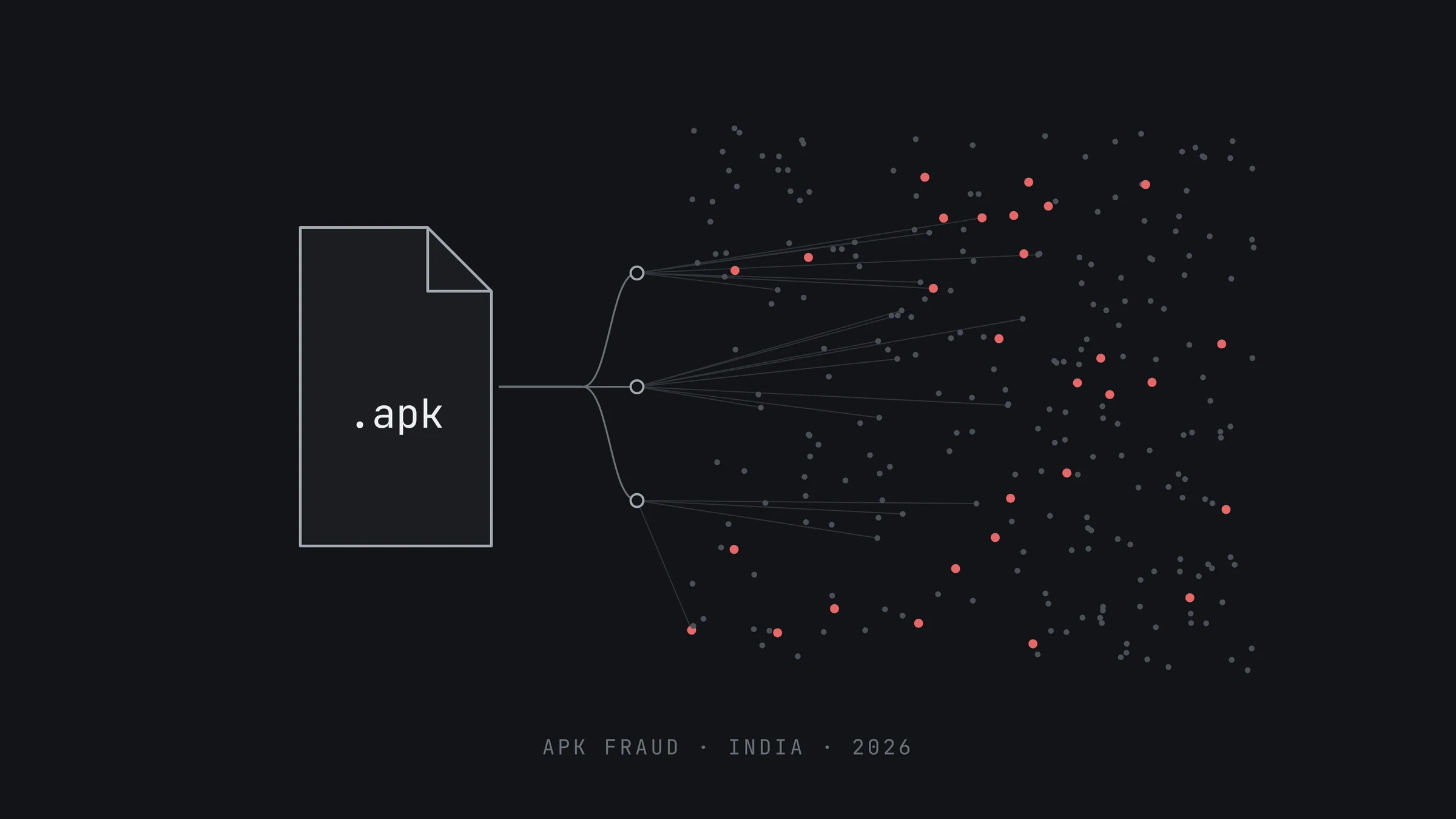
The payload fans out from there. In the self-propagating families, every infected phone forwards the link to the victim's own WhatsApp and Telegram contacts, so the message arrives from someone you actually know.
 An APK spreading from a single source across many phones
What's actually in the app
Indian threat-intel teams spent late 2025 pulling these apps apart. CYFIRMA's December 2025 report on RTO-challan fraud and Cyble's work on what it called "GhostBat RAT" describe the same playbook, and it is more deliberate than the clumsy lure suggests.
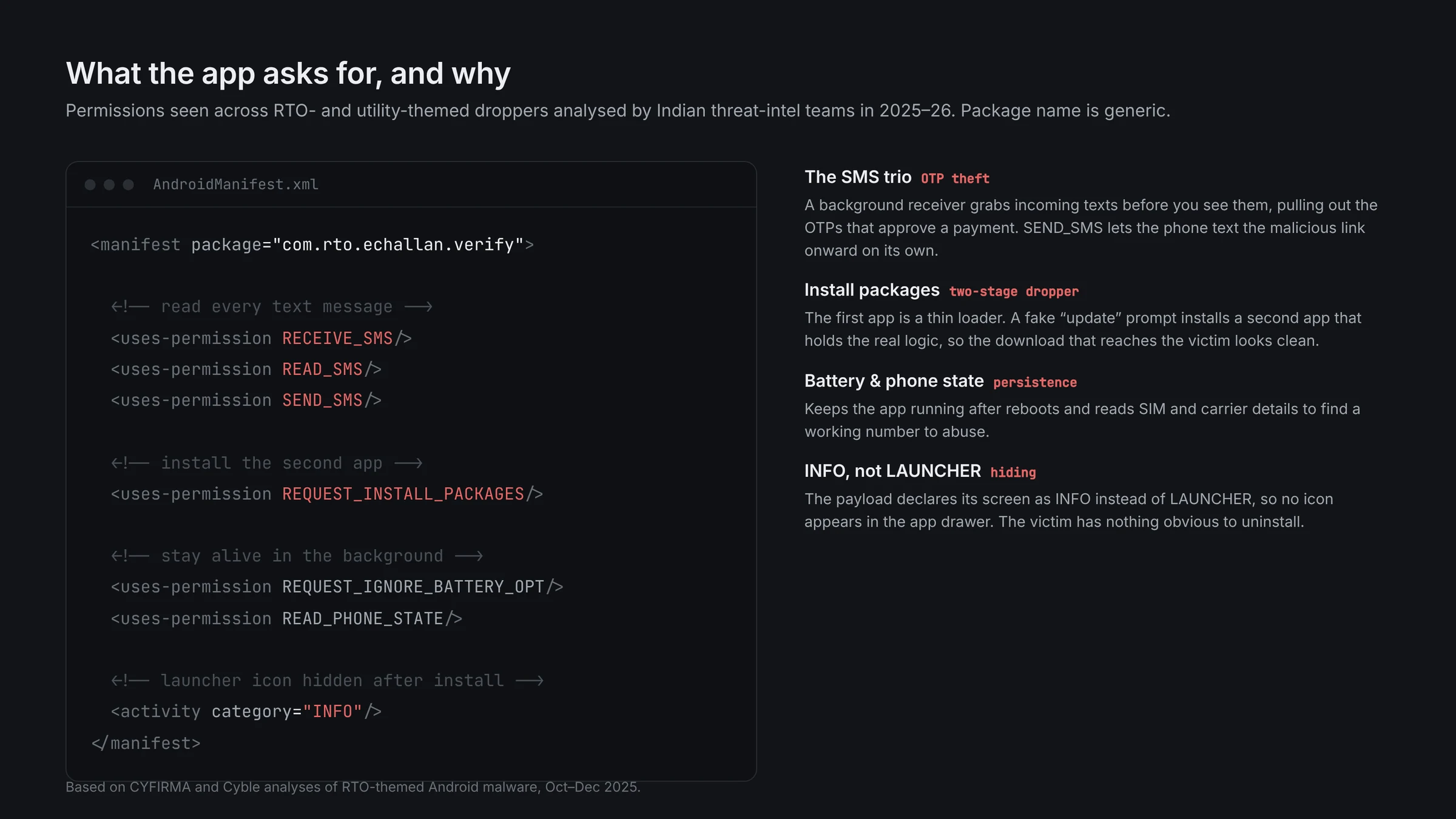 What the app asks for, and why
A few things stand out.
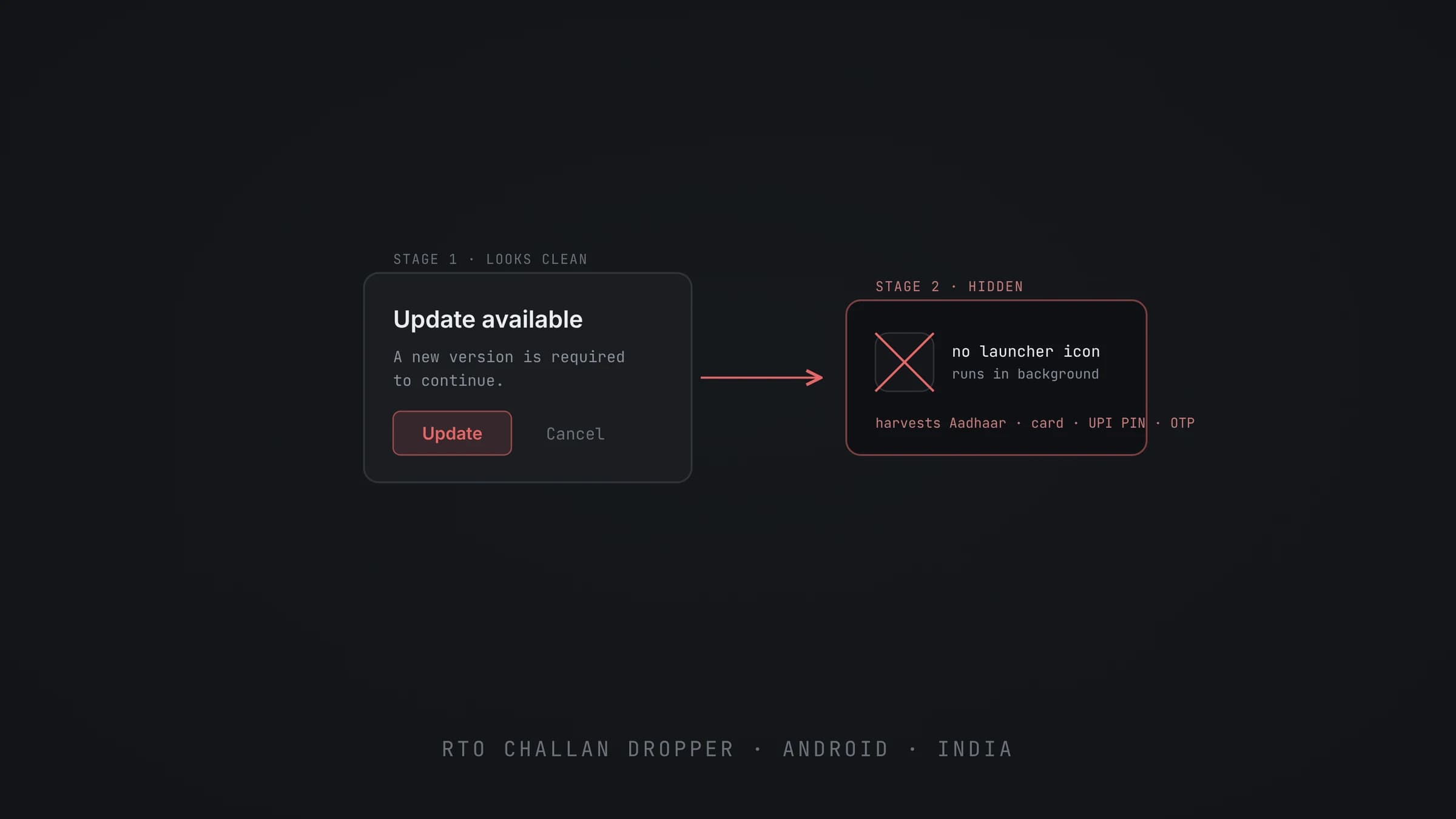
It comes in two stages. The app the victim first installs is a thin loader. On launch it shows a fake "update available" prompt; tapping it installs a second app carrying the real logic. This is why the file that reaches the victim can scan clean, and why the dangerous permissions only fully come together after the "update."
It lives on your SMS. The permissions that matter are RECEIVE_SMS, READ_SMS and SEND_SMS. A background receiver reads incoming texts, including the one-time passwords that authorise a bank transfer or a UPI payment, before you've even noticed them. SEND_SMS lets the phone quietly text the malicious link onward. The OTP is the thing the whole attack is built to steal, because the OTP is what the bank trusts.
It fakes the payment. The app shows a convincing e-challan screen, collects your name, date of birth, Aadhaar and PAN, then asks for a token "₹1 verification fee" with a promise of a refund. That fee screen is a credential harvester: it collects card number, expiry, CVV, ATM PIN, net-banking logins, even the UPI PIN. CYFIRMA noted the UPI payment is rigged to always fail, nudging victims toward entering card details instead.
It hides. After the second app installs, it declares its screen as INFO rather than LAUNCHER, so no icon shows up in the app drawer. There's nothing obvious to uninstall. Several families also ask for battery-optimisation exemptions to survive in the background, and some use VPN-service permissions and heavy obfuscation to stay quiet.
None of this needs a vulnerability in Android. It's all built from permissions the user granted and features the OS offers. The "exploit" is social.
It's a supply chain now
The most important part of the Gujarat case isn't the arrests. It's the structure the police described. This is no longer one scammer building one app.
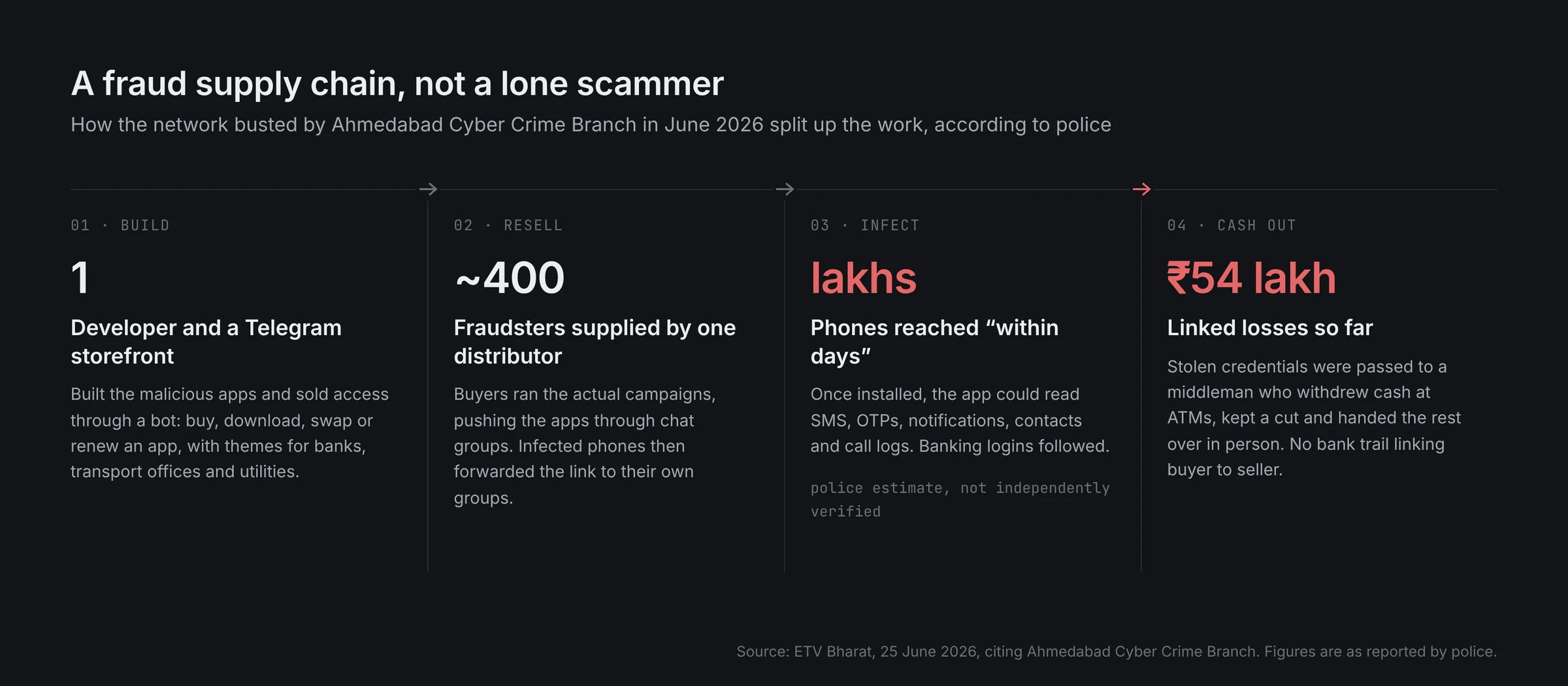 A fraud supply chain, not a lone scammer
According to the Ahmedabad Cyber Crime Branch, the key accused built the apps and ran a Telegram bot where buyers could purchase, download, swap and renew fraud apps, with templates impersonating SBI KYC and rewards, other banks, RTO services, electricity boards and government agencies. One distributor allegedly supplied the apps to around 400 other fraudsters. A third handled cash-out: stolen banking credentials and OTPs came in, cash came out of ATMs, a commission was kept, and the rest was handed over in person, so there was no direct bank trail between the buyer and the seller.
That last detail is the professional touch. The people sending the messages, the person who wrote the code, and the people turning credentials into cash are different, loosely linked actors. Arrest one node and the others keep running. The police put linked losses at about ₹54 lakh and claimed the apps had reached "lakhs" of phones, a figure worth treating as an estimate rather than a measurement.
This is the same commoditisation that turned ransomware into "ransomware-as-a-service." The barrier to entry is now a Telegram subscription, not coding skill.
Why the usual advice half-works
"Don't install APKs from outside the Play Store" is correct, and it is also not enough on its own, for three reasons:
- The sender is trusted. With self-forwarding malware, the link comes from a friend or family member's real account.
- The pretext is plausible. A traffic fine or a utility cut-off creates exactly the small, urgent, believable pressure that defeats caution.
- Sideloading is normal in India. Plenty of legitimate workflows involve installing APKs directly, so the warning doesn't carry the weight it should.
The structural fix is the two things that would break the chain regardless of the lure: stopping untrusted apps from touching SMS, and not trusting SMS OTPs as a sole second factor.
What to do
If you use an Android phone
- Never install an app from a link in a message, even from someone you know, and even if it's about a fine or a bill. Pay challans only through the official state transport or
mParivahanchannels you navigate to yourself. - A real government fine will never ask you to install an app, pay a "₹1 verification fee," or enter your UPI PIN to receive anything. You only ever enter a UPI PIN to send money.
- Keep Google Play Protect on. On newer Android versions, Play Protect blocks sideloading of apps that request sensitive permissions like SMS access during active scams.
- If a phone starts behaving oddly after a "challan" or "bill" app, assume SMS and banking are compromised: disconnect it, call your bank from another phone to freeze accounts, change banking passwords, and factory-reset the device. Report it on the national cyber-crime helpline 1930 or at cybercrime.gov.in.
If you run security for a bank or fintech
- Reduce reliance on SMS OTP. It is the single asset this entire ecosystem is built to steal. Push app-based approval bound to the device, and risk-score transactions so a first-time payee draining an account triggers a step-up or a hold.
- Watch for SIM/device signals: an OTP read and a high-value transfer completing within seconds, from a device that just enrolled, is the signature of this attack.
- Flag the fake-app patterns in your own telemetry: apps with SMS permissions requesting access near your banking app, new device bindings followed immediately by beneficiary additions.
For everyone
Tell the people in your life who are most likely to tap, often older relatives, one specific rule: a government department or a bank will never send you an app to install. That one sentence blocks most of this.
The takeaway
There's a reason this attack is everywhere despite being technically trivial: it doesn't fight the phone's security, it borrows the user's trust. The defenders' instinct is to look for a flaw to patch, and there isn't one. The weak points are a believable message and an OTP delivered over SMS.
The Gujarat bust is a good sign that police are treating this as organised crime rather than scattered fraud. But as long as the chain is this modular and the lure is this effective, arrests at one node won't stop it. The durable fixes are structural: break the app's hold on SMS, and stop letting a six-digit text be the thing that moves money.
This article reflects public information as of 2 July 2026.
Sources
- ETV Bharat: Gujarat Police bust pan-India APK fraud racket; three held
- The Bridge Chronicle: Two Punekars lost over ₹14 lakh in fake RTO e-challan APK scam
- CYFIRMA: RTO Challan Fraud – a technical report on APK-based financial and identity theft
- Cyble: GhostBat RAT – inside the resurgence of RTO-themed Android malware
- Moneylife: From e-challan and gas-bill updates to APK traps