Loud Claims, Quiet Breaches: What Hacktivist and Ransomware Claims Against India Actually Add Up To
Indian sites logged 15 lakh hacktivist attacks during Operation Sindoor, and ransomware gangs post a new Indian victim every day or two. I checked the claims against the evidence. The noisy side mostly fell apart; the quiet side is worse than the headlines.
On this page
Two kinds of attackers tell you about their own attacks. Hacktivists post screenshots on Telegram and X within minutes, because attention is the point. Ransomware gangs post victims on leak sites, because public pressure gets them paid.
Both are claims, written by the people making them. Over the last few weeks I added both to the India Threat Tracker and checked every notable claim I could against what security firms, police and the victims themselves later said. The two sides came out in opposite directions. The loudest claims mostly fell apart. The quiet ones are probably undercounted.
Part 1: the hacktivists
The numbers from Operation Sindoor
After the Pahalgam attack on 22 April 2025 and India's strikes under Operation Sindoor on 7 May, dozens of hacktivist groups rallied under the #OpIndia banner. The numbers that followed were huge:
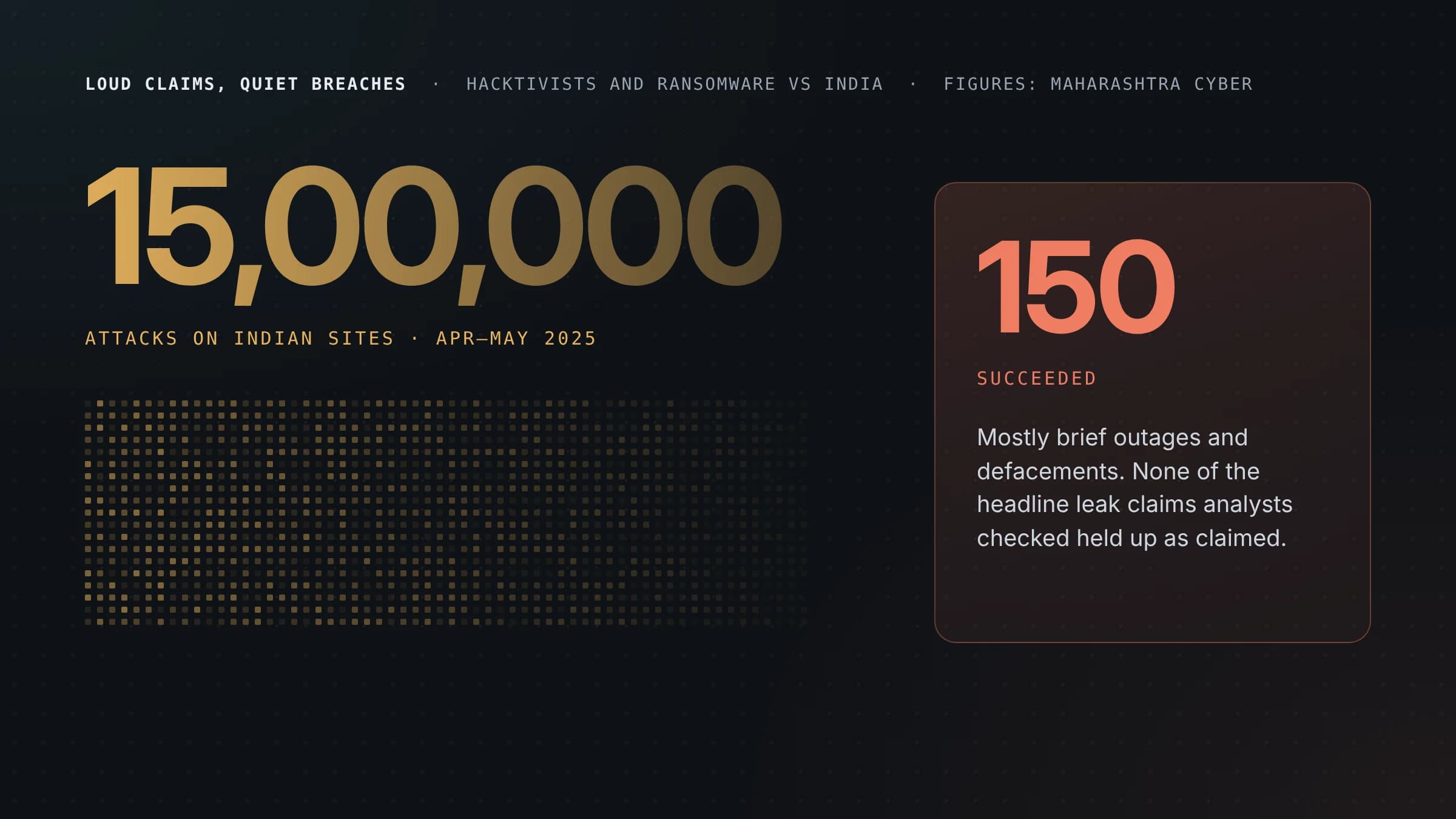
- About 15 lakh attacks on Indian critical-infrastructure websites, according to Maharashtra Cyber's "Road of Sindoor" report. 150 of them succeeded.
- 650+ confirmed DDoS and defacement events from more than 35 groups between 7 and 10 May, per Seqrite. Seven of those groups were brand new.
- 40+ groups tracked by Cyble. Just over half the attacks were DDoS and about 36% were defacements.
- 256 claimed DDoS attacks on 100 Indian organisations in 2025 up to 8 May, per Radware, peaking at seven claims an hour on the evening of 7 May.
Fifteen lakh attempts and 150 successes is a success rate of 0.01%. The successful attacks Maharashtra Cyber gave as examples were defacements of small sites: a municipal council in Maharashtra and a defence nursing college in Jalandhar.
What happened when someone checked
CloudSEK did what most coverage didn't: it pulled the samples behind the headline claims and looked at them. Maharashtra Cyber separately listed the claims it had found to be false. Here are the nine I could match to a verdict:
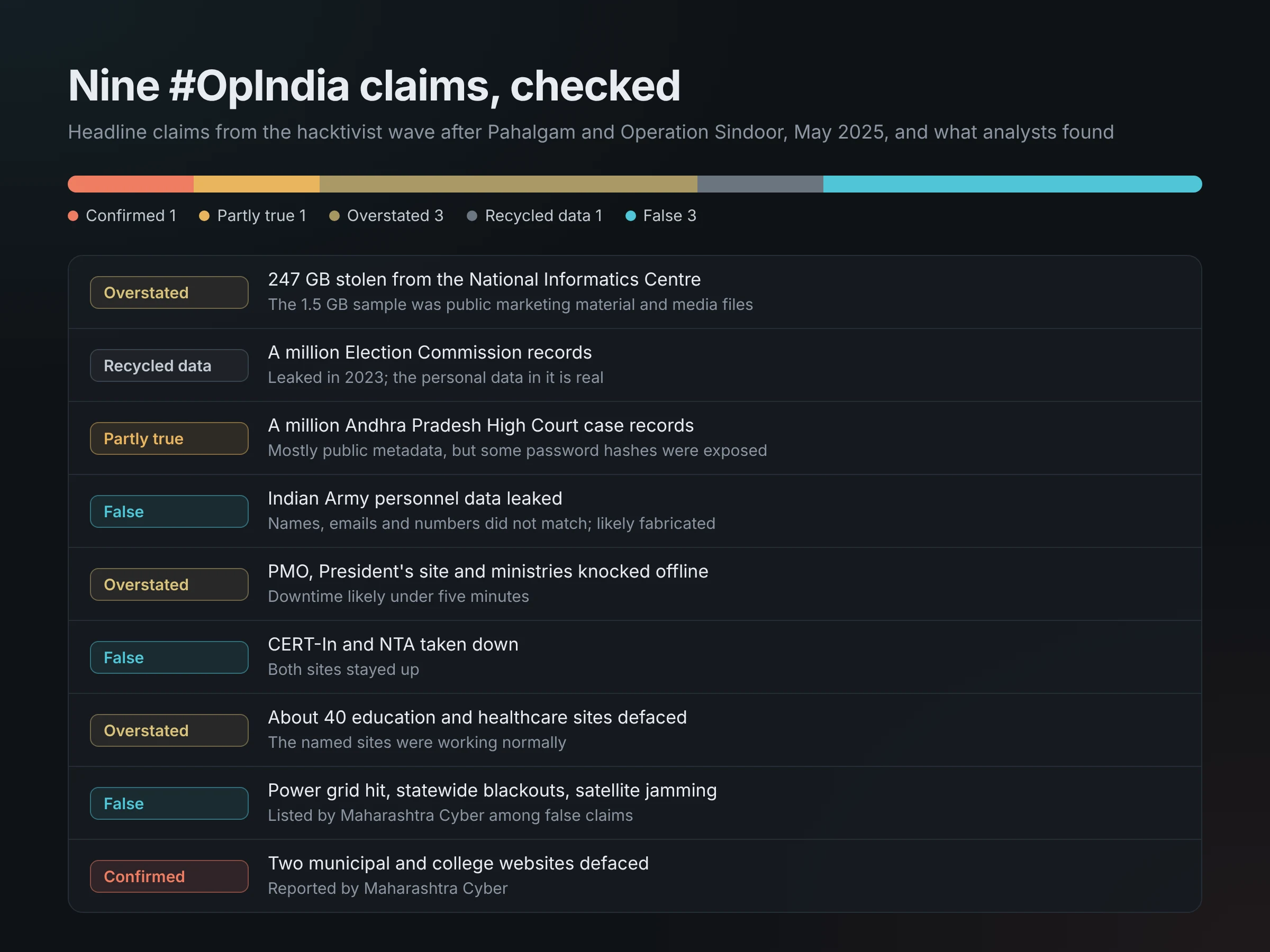 Nine headline #OpIndia claims and what analysts found when they checked them
A few stand out:
- "247 GB from the National Informatics Centre." The 1.5 GB sample was public marketing material and media files.
- "A million Election Commission records." Real personal data, but it leaked in 2023. Old data, new headline.
- "A million Andhra Pradesh High Court records." Mostly public case metadata, but some password hashes were in there. This is the one that deserved a response, and it's the least dramatic of the lot.
- DDoS on the PMO, the President's site and ministries. Downtime was likely under five minutes.
- Power grid down, statewide blackouts, satellite jamming. None of it happened.
One claim in nine held up in full: the defacements. That isn't a reason to ignore hacktivists. The recycled Election Commission data contains real personal information, and the High Court hashes were a real exposure. But the effort should go to the one claim in nine that holds up, not the eight that don't.
Who's doing it
Most of the volume comes from a handful of groups, and they aren't all from Pakistan:
- RipperSec (Malaysia) made over 30% of DDoS claims against India in early 2025. It maintains MegaMedusa, a public Node.js tool for application-layer floods that anyone can install from GitHub.
- AnonSec made about 17% and Keymous+, which calls itself North African, about 10%. Radware has found evidence that Keymous+ runs or is closely tied to EliteStress, a DDoS-for-hire service selling attacks from €5 a day. Some of this "activism" is a sales pitch.
- Mysterious Team Bangladesh has aimed most of its attacks at India since 2022. Group-IB counted 750+ DDoS attacks and 78 defacements, the defacements likely through outdated WordPress and phpMyAdmin installs.
- Pakistan Cyber Force claimed in March 2026 to have hijacked ABP News to air Pakistan Army content. That one is still unverified.
The real threat in the same weeks
While everyone watched the DDoS dashboards, APT36 (Transparent Tribe) was sending Indian government and defence staff Pahalgam-themed PowerPoint add-ins that installed Crimson RAT, and PDFs that led to credential-phishing pages on lookalike Indian Air Force and J&K Police domains. CloudSEK called it the more serious threat of the period, and it was. A defaced college website is embarrassing. A RAT on a defence officer's laptop is espionage.
Part 2: ransomware
Ransomware has the opposite problem. Leak sites name victims, and most victims never say a word.
What gets counted
- 77 claimed ransomware attacks on India in H1 2026, ninth worldwide and second in Asia-Pacific after Thailand (Cyble).
- 24 claimed Indian victims in August 2026 alone, the most of any Asia-Pacific country that month (Cyble).
- 238+ Indian organisations posted on leak sites in the 12 months to 19 October 2026, according to Threat Atlas India's count from ransomware.live and RansomLook.
These counts have their own problems. Leak sites miss victims who pay quietly, and gangs sometimes post false or recycled claims. But they are the closest thing to a census we have.
What gets confirmed
Now compare that with the Indian incidents that became public with a name attached:
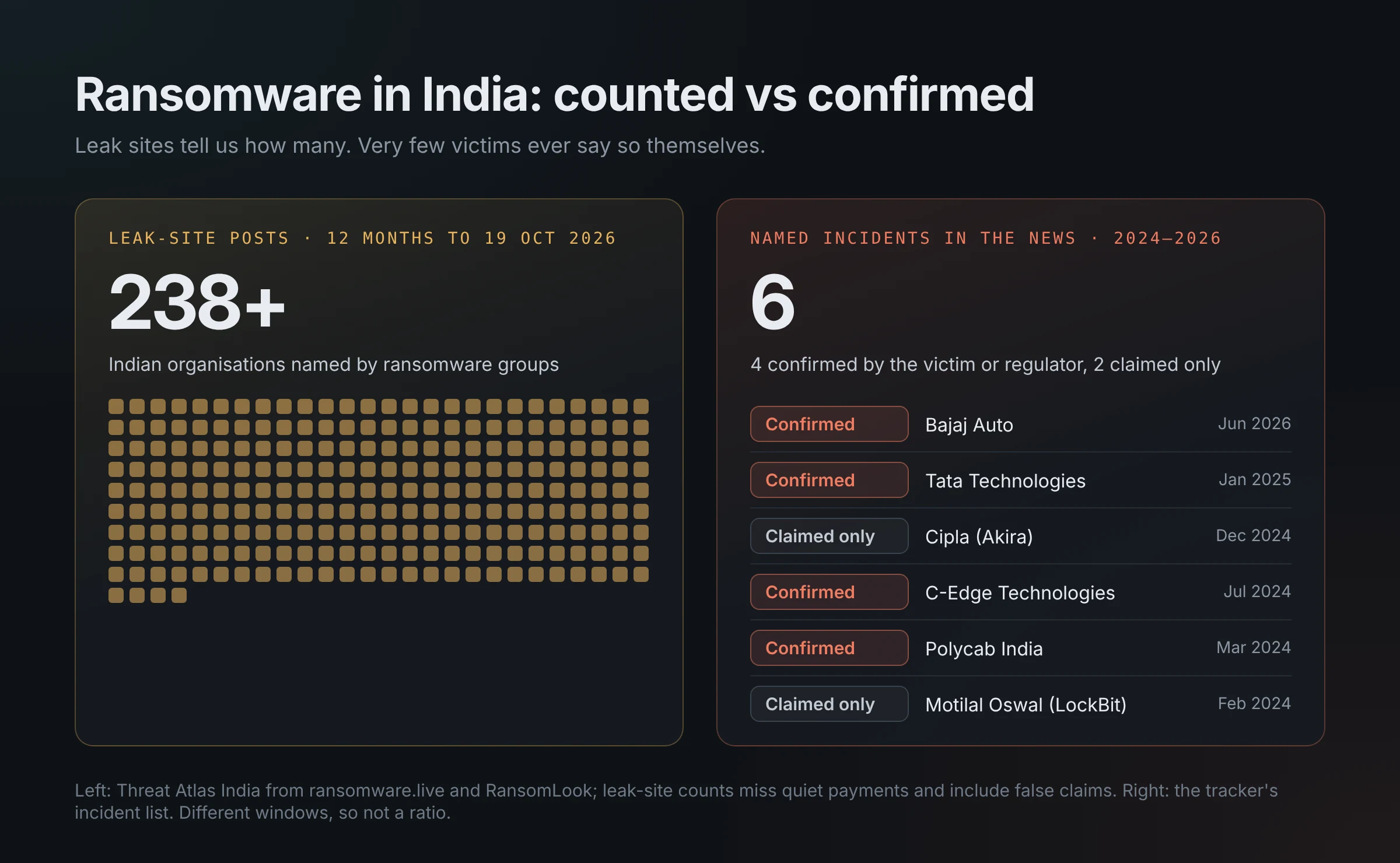 Leak-site counts compared with the named Indian ransomware incidents that made the news
The two panels cover different windows, so they aren't a ratio, but the gap is the point. Over about two and a half years I found six Indian ransomware incidents with a name in mainstream reporting. Four were confirmed by the victim or a regulator:
- Polycab India (March 2024) disclosed an attack on its IT infrastructure and said core systems were unaffected.
- C-Edge Technologies (July 2024). More on this one below.
- Tata Technologies (January 2025) told the NSE ransomware hit "a few" IT assets. Two months later Hunters International claimed 1.4 TB of data.
- Bajaj Auto (June 2026) disclosed ransomware affecting its IT infrastructure and a subsidiary, and notified CERT-In.
The other two were leak-site claims that the companies never confirmed: LockBit's listing of the brokerage Motilal Oswal in February 2024, and Akira's claim of 70 GB from Cipla in December 2024.
Three of the four confirmed cases are listed companies, which SEBI's disclosure rules push to say something. The fourth, C-Edge, became public because NPCI had to cut it off and hundreds of banks went down with it. Unlisted companies, hospitals and small businesses report to CERT-In, and those reports aren't public. That is probably where most of the 238 sit.
The one that showed how fragile it is
The C-Edge incident deserves a closer look, because the banks it affected never had a chance to defend themselves.
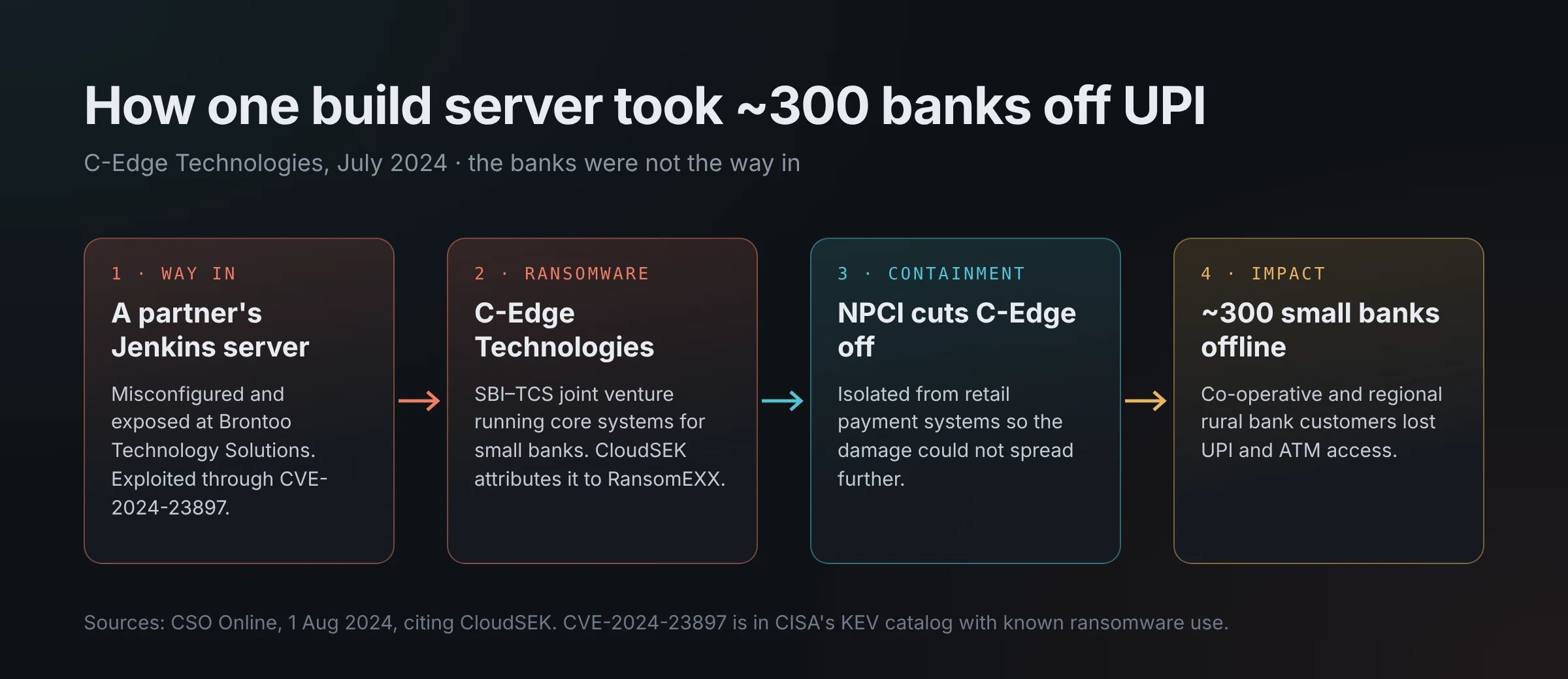 How a partner's exposed Jenkins server led to about 300 small banks losing UPI and ATM access
C-Edge, a joint venture of SBI and TCS, runs core systems for co-operative and regional rural banks. According to CloudSEK, the attackers got in through a misconfigured Jenkins server at a partner, Brontoo Technology Solutions, using CVE-2024-23897, and CloudSEK attributes the ransomware to RansomEXX. NPCI cut C-Edge off from retail payment systems to stop the spread, and customers of nearly 300 small banks lost UPI and ATM access. NPCI's quick isolation was the right call, and it's still a lesson: one exposed build server two companies away took out payments for hundreds of banks.
That Jenkins flaw is in CISA's Known Exploited Vulnerabilities catalog with known ransomware use. So is CVE-2024-40766 in SonicWall SSL VPN, which Cyble says Akira is still exploiting in 2026, two years after the patch.
Who's posting Indian victims now
- The Gentlemen, a group that appeared in 2025, probably from affiliates of the Qilin ecosystem, led Asia-Pacific in 2026. LevelBlue counted 12 Indian victims among the 352 on its leak site by May. It gets in through exposed VPNs and firewalls and spreads ransomware across a domain through Group Policy.
- Qilin was the most prolific group worldwide in August 2026, with 147 claims.
- LockBit is still active: 38 Asia-Pacific victims in the first half of 2026.
What the two sides have in common
Put the two halves together and a few things are clear.
- Check a leak claim before reacting to it. In the #OpIndia wave, the sample was usually old or public data. If your organisation's name appears, check the sample, then rotate anything real that's in it.
- The real damage came through ordinary doors. A partner's exposed Jenkins server. An unpatched VPN. A PowerPoint add-in in a phishing email. None of these is new, and all of them are on the tracker's watchlist.
- DDoS defence is cheap compared with the panic. Application-layer protection, origin servers that only accept traffic from your CDN, and rate limits on expensive pages handle almost all of what hacktivists throw. Expect it around every India-Pakistan flashpoint, and on Friday evenings, when staff are thin.
- The quiet side needs more disclosure, not less. Listed companies tell us about their incidents because they have to. Everyone else's ransomware incidents mostly go unrecorded in public, which makes it harder for the next victim to learn from them.
How the tracker records this
Both sides are now in the India Threat Tracker, with a rule for each:
- Hacktivists: every notable claim carries the verdict its source reached (confirmed, partly true, overstated, recycled, false or unverified). The tracker never upgrades a claim on its own.
- Ransomware: incidents are marked confirmed or claimed only, and each group says how strong its link to India really is. Organisations named only on a leak site are counted but never named. CI fails the build if a claimed incident is ever worded as confirmed.
The data is open: hacktivist.json and ransomware.json, with a STIX 2.1 export for CTI platforms. If you know of an Indian incident that was confirmed and isn't there, or a claim that has since been checked, open an issue.
Sources
- ThePrint (PTI): Pakistan-allied hackers launched 15 lakh cyber attacks on Indian websites, only 150 successful
- CloudSEK: Brief disruptions, bold claims, the tactical reality behind the India-Pakistan hacktivist surge
- Seqrite: Operation Sindoor, anatomy of a digital siege
- Radware: Escalating hacktivist attacks amidst India-Pakistan tensions
- Dark Reading: After Pahalgam attack, hacktivists unite under #OpIndia
- Radware: MegaMedusa, RipperSec's public web DDoS attack tool
- Radware: Keymous+, a new hacktivist collective or a DDoS-as-a-service brand?
- Group-IB: Mysterious Team Bangladesh
- Arab News Pakistan: "Pakistan Cyber Force" group hacks India's ABP News
- Entrepreneur India: India second most ransomware-targeted APAC nation in H1 2026 (Cyble)
- CXO Digital Pulse: India tops Asia-Pacific ransomware claims in August 2026 (Cyble)
- Threat Atlas India: Ransomware in India
- CSO Online: Over 300 Indian banks suffer payment disruption from ransomware attack
- iTnews Asia: Polycab India's IT infrastructure targeted by ransomware attack
- The Record: Tata Technologies reports ransomware attack to Indian stock exchange
- Security Affairs: Hunters International claims 1.4 TB from Tata Technologies
- Security Boulevard: Bajaj Auto confirms systems affected by ransomware attack
- TechCrunch: LockBit claims cyberattack on Indian brokerage Motilal Oswal
- Cyber Security News: Cipla allegedly hacked
- LevelBlue SpiderLabs: A closer look at The Gentlemen's alleged leak