India Threat Landscape #02: Ivanti Again, China Moves Onto the Banks, and a 12-Hour Patch Clock
The second issue of the brief. October brought another Ivanti Connect Secure chain, a run of web-stack bugs from PHP to Node.js, China-nexus espionage aimed at Indian banks and government, and fraud fed by leaked customer data. Plus three new detections and two new feeds in the tracker.
On this page
- 1.1. Ivanti again, and a 12-hour patch window
- 2.2. China-nexus espionage reached Indian banks and government
- 3.3. The web stack had a bad month
- 4.4. Fraud runs on stolen trust
- 5.5. Ransomware and hacktivists: opposite problems
- 6.New in the tracker
- 7.What to actually do this month
- 8.Use the tracker
- 9.The takeaway
- 10.Sources
The first issue came out three weeks ago, when the India Threat Tracker launched. This one covers October and the start of November: what changed, what matters for defenders here, and what I added to the tracker.
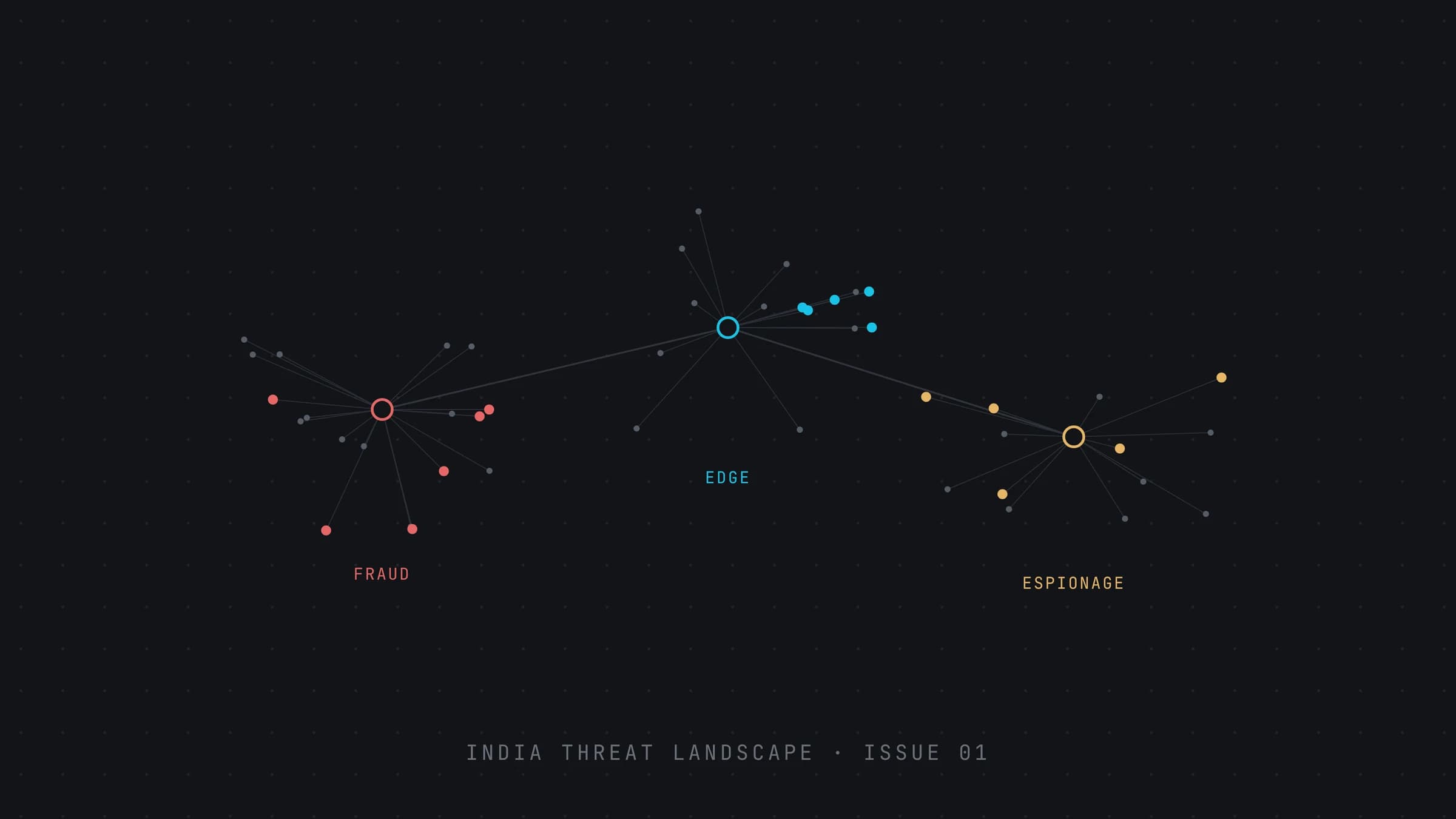
Two things changed since last time. China-nexus espionage moved from India's power grid onto its banks and government desks. And the time you get to patch shrank again, both because attackers moved faster and because CERT-In now expects you to.
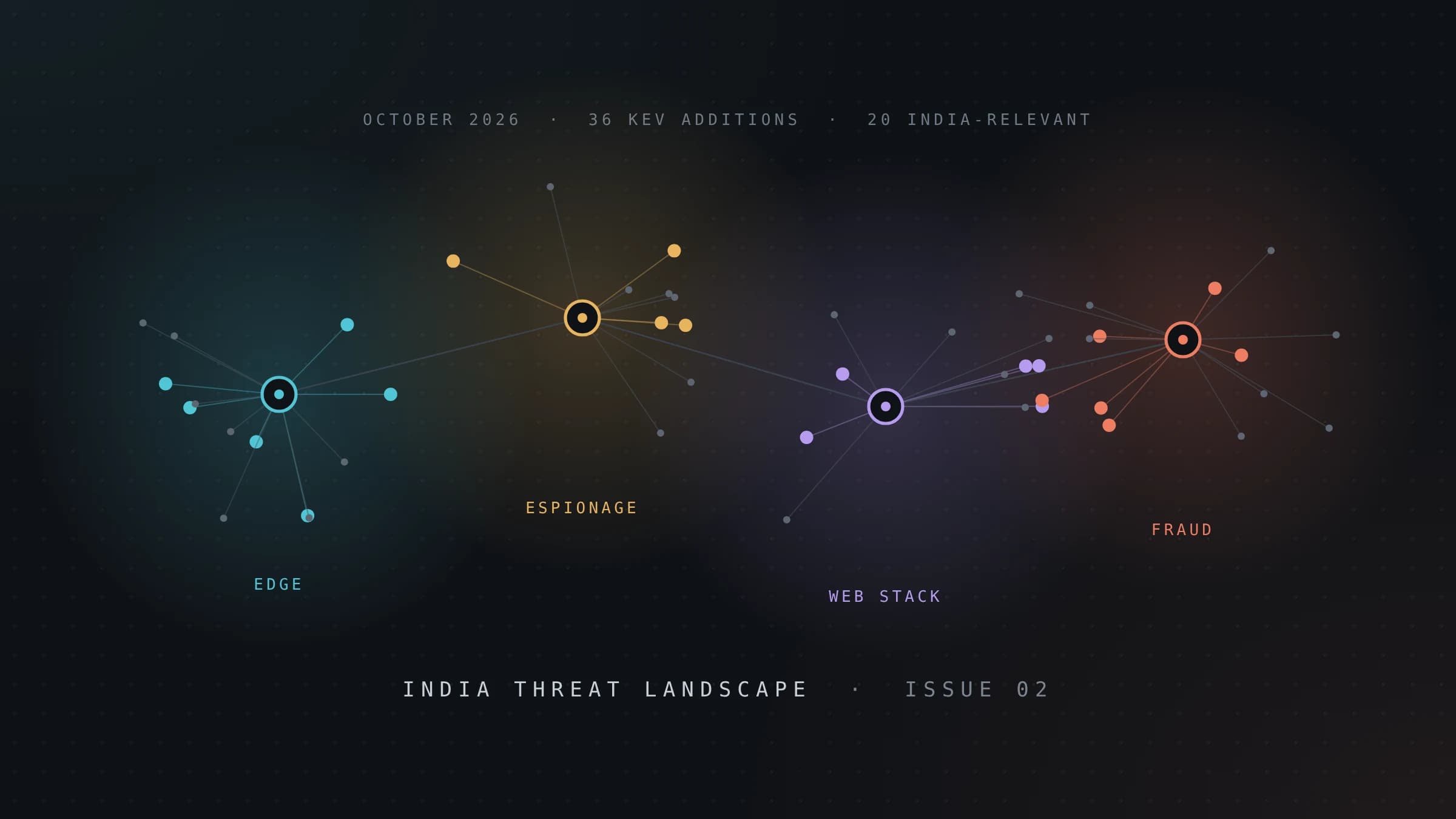
First, the numbers. CISA added 36 flaws to its Known Exploited Vulnerabilities (KEV) catalog in October. The tracker tags 20 of them as relevant to India, 13 of those as high, because they hit products with a big Indian footprint: Fortinet, Citrix, Ivanti, Palo Alto, Cisco, Atlassian, GitLab, VMware and PHP. The relevance tag is a keyword heuristic, not proof that anyone here is exposed, but it is a good place to start your patch list.
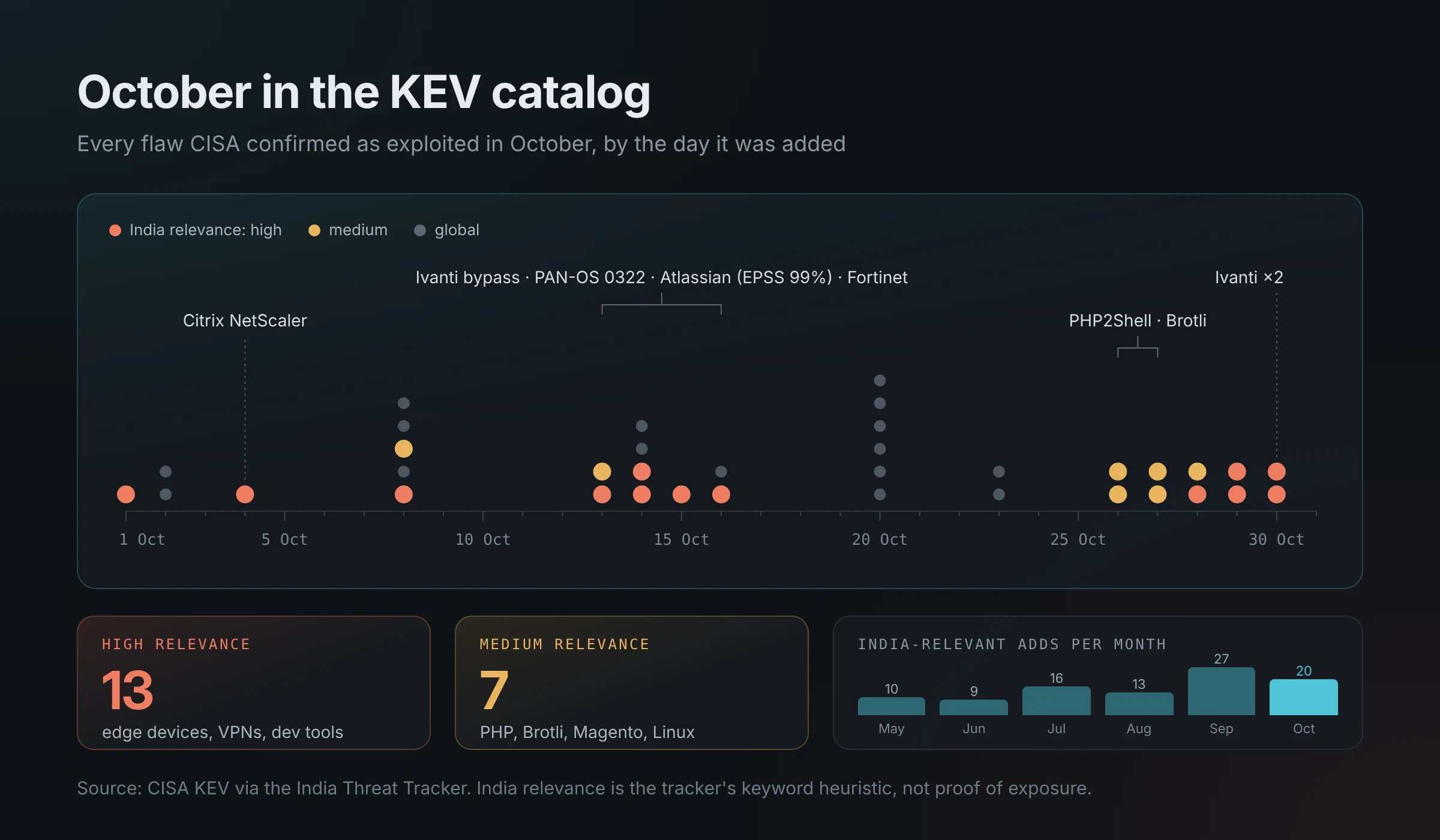 India-relevant KEV additions, October 2026
1. Ivanti again, and a 12-hour patch window
If you run Ivanti Connect Secure, October was rough. CISA added an authentication bypass (CVE-2026-104935) to KEV on 13 October, then two more flaws (CVE-2026-111357 and CVE-2026-118527) on 30 October. Volexity documented the three chained together into unauthenticated root on the VPN appliance, used by an actor it hadn't seen before and calls UTA0576.
What UTA0576 did once inside is the interesting bit. No web shell, no malware. It took credentials and some Active Directory data, looked around the host, and searched for administrator passwords and BitLocker recovery keys. That is an attacker setting up for later, not one in a hurry.
The rest of the edge list kept growing too: FortiMail (1 Oct), Citrix NetScaler (4 Oct), PAN-OS CVE-2026-0322 (14 Oct), Cisco Secure Email Gateway (14 Oct), another Fortinet flaw (16 Oct) and Cisco ASA/FTD (29 Oct). An Atlassian flaw added on 15 October has an EPSS score around 99%, which means expect it to be scanned for everywhere.
Then there's the clock. CERT-In's May 2026 guidance asks organisations to fix exploited internet-facing flaws within 12 hours where feasible. Most teams can't do that for a VPN appliance yet. But it does settle the argument about whether an edge patch can wait for next week's change window.
If you had an exposed Ivanti box before you patched, treat it as a credential-theft incident: patch, run Ivanti's integrity checker, and rotate anything the appliance could see. Then check who has been reading BitLocker recovery keys from AD, which brings me to the first new detection (more below).
2. China-nexus espionage reached Indian banks and government
For years, the China-nexus story in India was mostly the power grid: RedEcho and TAG-38 going after load dispatch centres. In 2026, Mustang Panda widened it.
- Banks (from March): help-file attachments made to look like HDFC Bank support tickets, which installed the LOTUSLITE backdoor. Acronis published the findings in April.
- Government (June): implants beaconing from Indian government networks between 12 and 22 June, including machines used by senior administrative staff, using hydropower and India-Taiwan lures. Acronis worked with CERT-In on the clean-up.
The command channel is the part I'd pay attention to. The ZOHOMURK implant talks to an attacker-owned Zoho WorkDrive account through Zoho's API. Plenty of Indian offices use Zoho, so the traffic blends in with real work and a domain blocklist won't help. What doesn't blend in is which process is calling the API. A browser or the Zoho client making that call is normal. A side-loaded binary in ProgramData is not. That's the second new detection.
Full timeline on the tracker's Mustang Panda profile.
3. The web stack had a bad month
Three things in two weeks, all of which I wrote up separately:
- PHP2Shell: two PHP flaws leaked before the patch, got a public exploit, and entered KEV on 26 October with EPSS near 100%. PHP branches that are already out of support get no fix at all.
- Node.js and Brotli: a Brotli decoder flaw that Node.js says allows remote code execution, added to KEV on 27 October. You reach it through what your server downloads with
fetch(), not just what it receives. - eMudhra: browsers and Node.js stopped trusting some eMudhra intermediate certificates after their private keys turned out to be recoverable. CERT-In issued an advisory (CIAD-2026-0050).
The common fix: upgrade the runtime itself, not just your app's dependencies, and check whether anything you run relied on the affected eMudhra intermediates.
4. Fraud runs on stolen trust
Fraud against ordinary people is still the biggest threat in the tracker by volume, and it keeps getting more organised. I4C counted more than 30,000 victims and over ₹1,500 crore lost to fake stock-tip groups and trading apps in six months. Fake APKs still do the technical work, like the "wedding invitation" that installs SpyMax and reads bank OTPs from notifications.
What's new is the data feeding it. On 21 October SBI confirmed that personal data of at least 3,897 customers (names, mobile numbers, dates of birth, addresses and internal IDs) turned up in a dark-web set of about 3.75 lakh records. A list like that is what makes a fake bank or "police" call sound real. If you build verification at a bank, assume the caller already knows the customer's details, and don't let knowing them count as proof.
5. Ransomware and hacktivists: opposite problems
I spent part of the month on these two, and the full piece is Loud Claims, Quiet Breaches. The short version: hacktivist claims against India are loud and mostly don't hold up. Of nine headline claims from the Operation Sindoor wave that someone actually checked, three were outright false and only one was confirmed. Ransomware is the opposite. Cyble counted 77 claimed attacks on Indian organisations in the first half of 2026 and 24 in August alone, yet only a handful of victims ever say anything publicly.
One group worth naming is The Gentlemen, the most active ransomware group in Asia-Pacific this year. LevelBlue counted 12 Indian victims on its leak site by May. It gets in through exposed VPNs and firewalls (see section 1) and then pushes the ransomware across the whole domain through Group Policy. That domain-wide step is the third new detection.
New in the tracker
 Three new detections
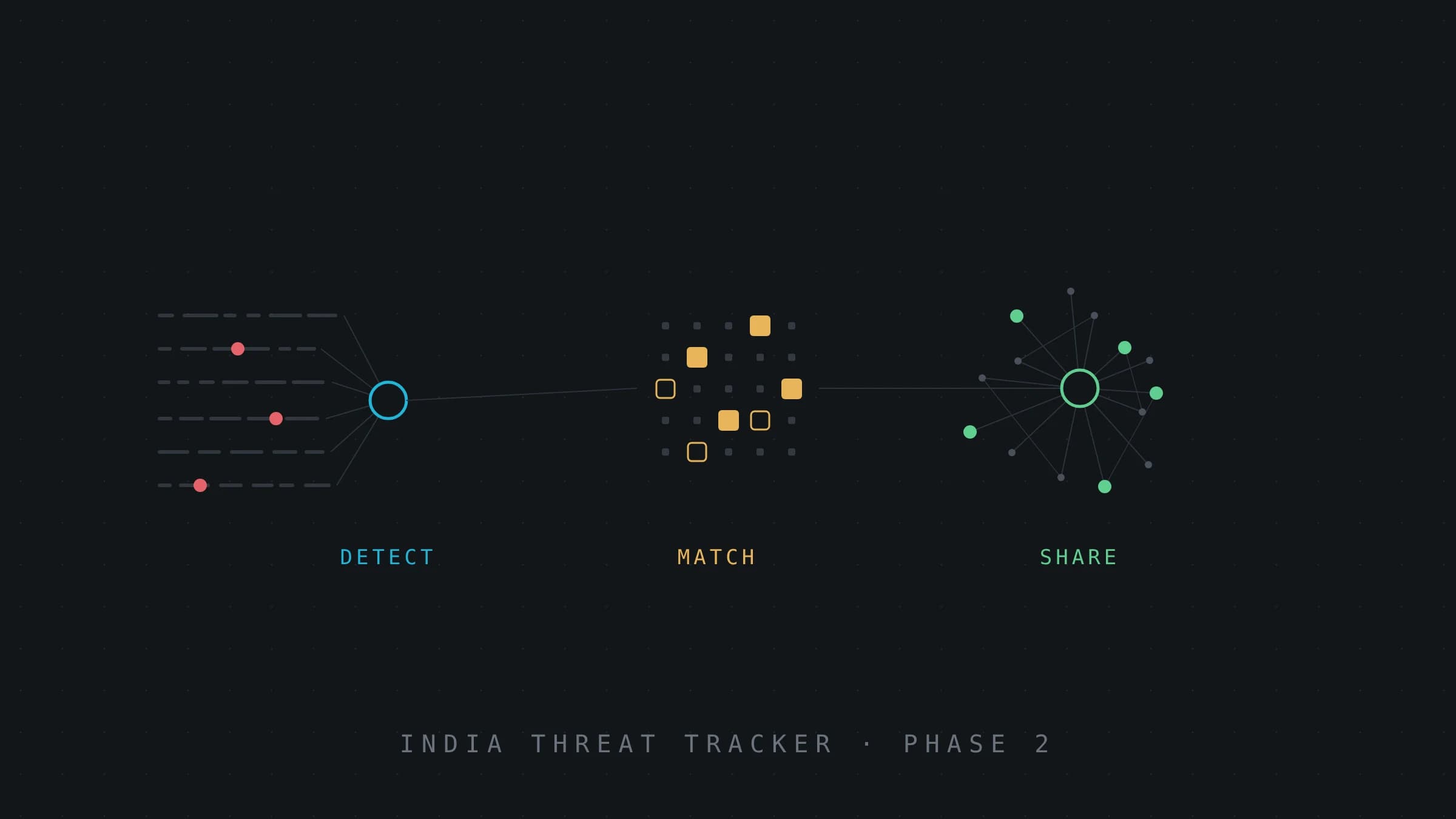
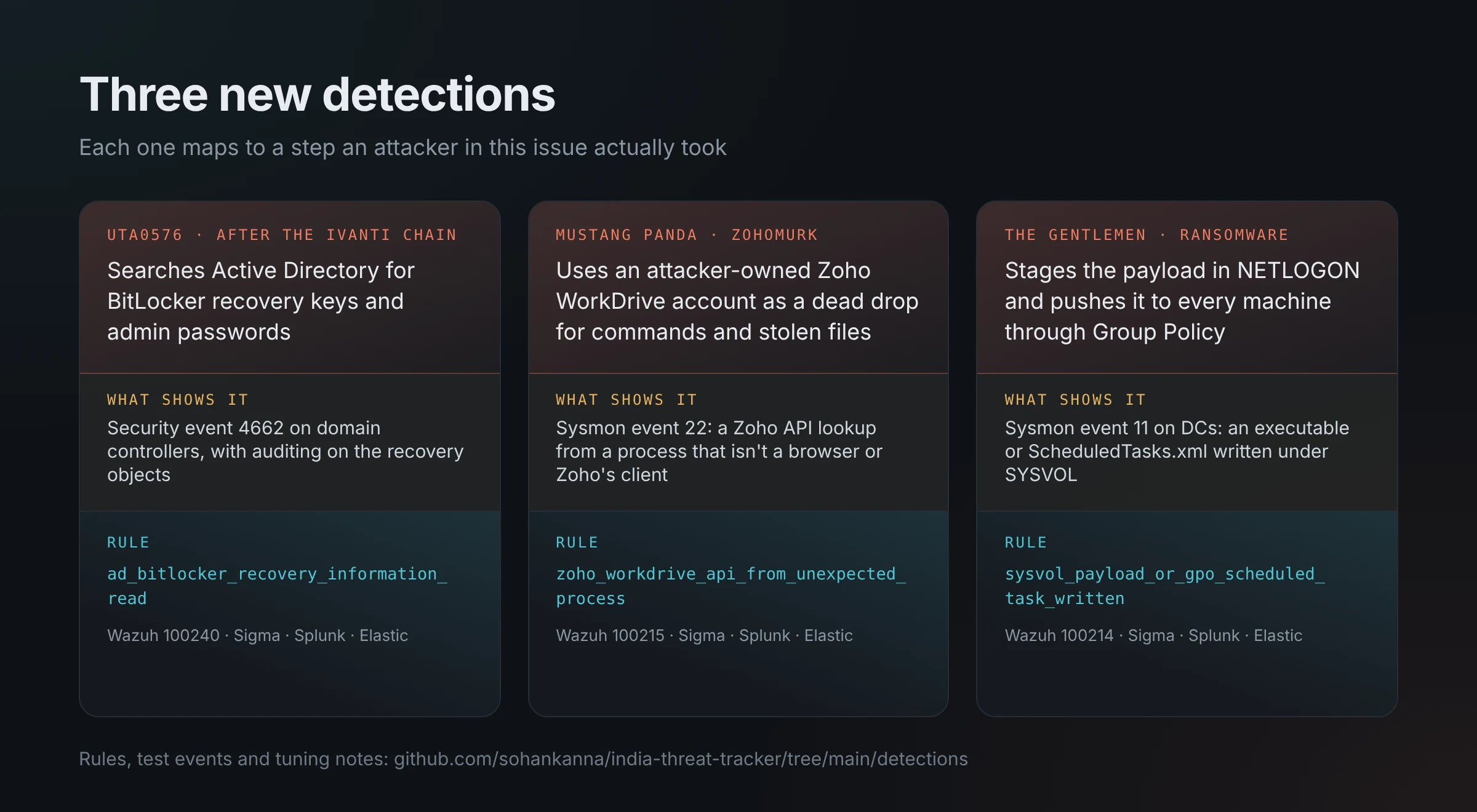
- Three new detection rules, bringing the pack to nine. Each comes in Sigma, Splunk, Elastic and Wazuh formats with test events, and the Wazuh versions are replayed against a real Wazuh manager in CI:
ad_bitlocker_recovery_information_read: a user account reading BitLocker recovery information from Active Directory (Security event 4662). This is the first rule built on the Windows Security log.zoho_workdrive_api_from_unexpected_process: a Zoho API or WorkDrive DNS lookup from a process that isn't a browser or a Zoho client (Sysmon event 22).sysvol_payload_or_gpo_scheduled_task_written: an executable, script or Group Policy scheduled task written under SYSVOL on a domain controller (Sysmon event 11).
- A ransomware feed: six groups with how strongly each is linked to India, six named Indian incidents marked confirmed or claimed, and the landscape numbers with what each one actually counts. Organisations that only appear on leak sites are never named.
- A hacktivist feed: each notable claim against India with a verdict (confirmed, partly true, overstated, recycled or false) and the evidence for it.
- The November assessment: the five items above, ranked, with every claim linked to the feed entry or source behind it.
What to actually do this month
- Ivanti Connect Secure: patch, check integrity, and if it was exposed before patching, rotate the credentials it could see. Assume this one was hit, don't just hope it wasn't.
- Work out what "12 hours" means for you. Pick the five internet-facing products you'd have to patch overnight and write down who can approve it at 2 am.
- Audit who can read BitLocker recovery keys in AD. It should be a small helpdesk group, not every admin. Turn on auditing for those reads (the new rule's docs say how).
- Upgrade PHP and Node.js runtimes, and get anything on an out-of-support PHP branch onto a supported one.
- Banks and fintechs: stop treating "the caller knew my details" as verification. After the SBI leak, it proves nothing.
Use the tracker
Everything above is open data. To pull it:
# this month's India-relevant KEV additions
curl -s https://raw.githubusercontent.com/sohankanna/india-threat-tracker/main/data/exploited-cve.json \
  | jq '.items[] | select(.date_added >= "2026-10-01" and .india_relevance == "high") | {cve, vendor, product, epss}'

# the November assessment, ranked
curl -s https://raw.githubusercontent.com/sohankanna/india-threat-tracker/main/data/assessment.json \
  | jq '.items[] | {rank, title, severity}'
The new rules are in detections/. If one of them fires on something legitimate in your environment, open an issue; that's the fastest way they get better.
The takeaway
October's threats weren't new kinds of threat. They were the same ones, faster: edge appliances exploited before the fix is out, espionage hiding in cloud services Indian offices already trust, and fraud that now comes with the victim's real details. The defences haven't changed much either. They just have less time.
More next month.
This article reflects public information as of 4 November 2026. The India Threat Tracker is updated twice a day.
Sources
- India Threat Tracker (data, detections, feeds)
- CISA Known Exploited Vulnerabilities catalog
- The Hacker News: Attackers chain three Ivanti Connect Secure flaws (Oct 2026)
- The Hacker News: CERT-In sets 12-hour patching for exploited internet-facing flaws (May 2026)
- The Hacker News: Mustang Panda's new LOTUSLITE variant targets Indian banks (Apr 2026)
- The Hacker News: Mustang Panda uses Zoho WorkDrive as C2 against India's government and energy sectors (Jun 2026)
- CERT-In advisory CIAD-2026-0050: eMudhra intermediate CA certificates
- The Hacker News: State Bank of India confirms data leak (Oct 2026)
- Business Today: Over 30,000 Indians duped in investment scams (I4C, Oct 2025)
- K7 Labs: SpyMax fake wedding invitation app targeting Indian users
- Entrepreneur India: India second most ransomware-targeted APAC nation in H1 2026 (Cyble)
- CXO Digital Pulse: India tops Asia-Pacific ransomware claims in August 2026 (Cyble)
- LevelBlue SpiderLabs: A closer look at The Gentlemen's alleged leak
- Microsoft Learn: ms-FVE-RecoveryInformation class
Related research
More deep dives →