India Threat Tracker v1.0: A MISP Feed, CERT-In Coverage and a Watch on Fake Bank Domains
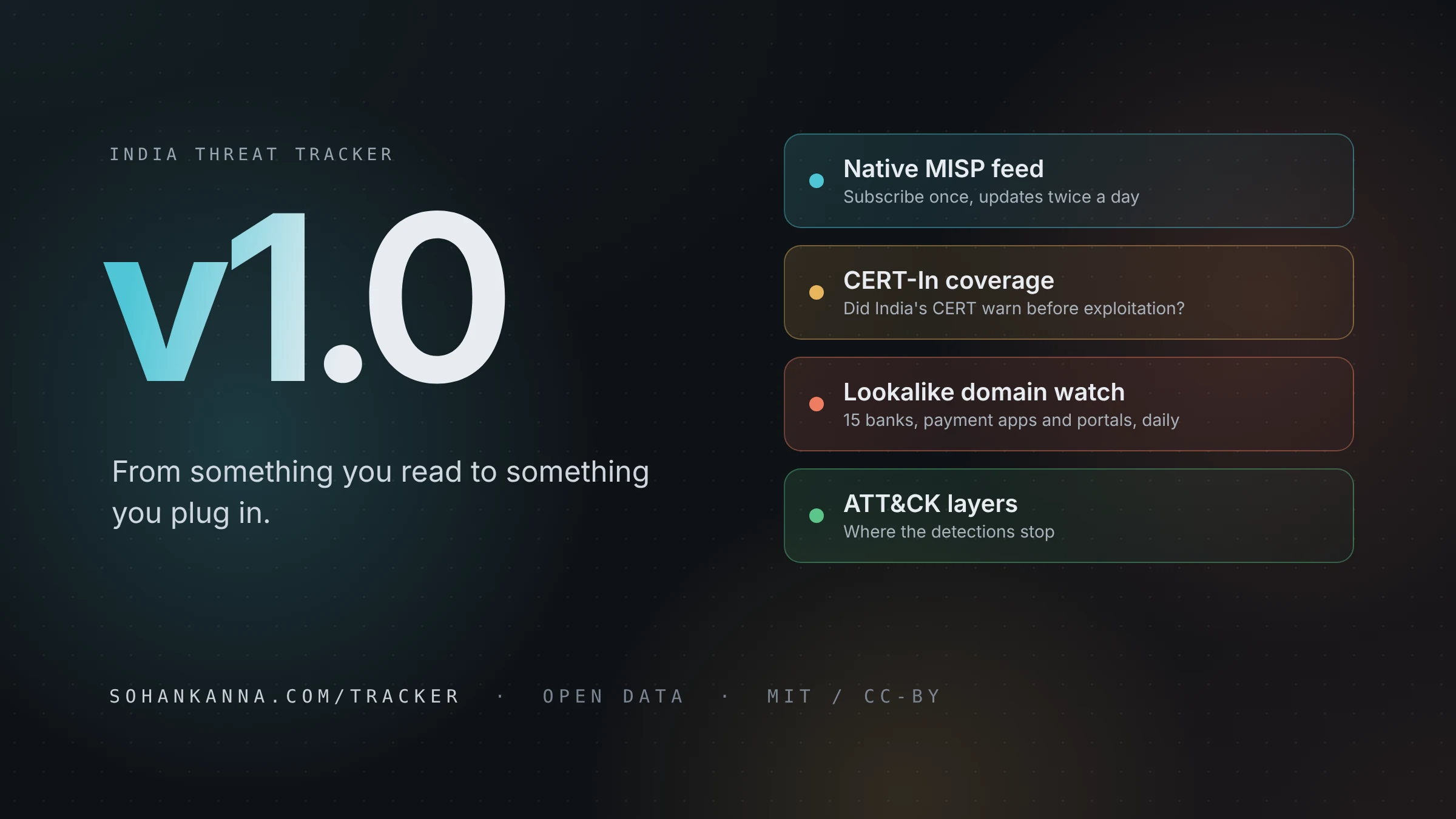
v1.0 turns the tracker from something you read into something you plug in: a native MISP feed, versioned downloads, a daily watch on lookalike domains of Indian banks and government sites, a check of which exploited flaws CERT-In warned about, and ATT&CK layers that show where my own detections stop.
On this page
For the last few weeks the India Threat Tracker has been a good thing to read and an awkward thing to use. If you wanted the data in your SOC you had to write your own script against the JSON. That was fine for me and not much use to anyone else.
v1.0 is about fixing that. It adds a feed you can subscribe to, two new data sources nobody else publishes for India, and an honest map of what my detections cover and what they don't. Here's what's new and how far each part has been tested.
1. Subscribe to it from MISP
The tracker is now a native MISP feed. In MISP, go to Sync Actions → Feeds → Add Feed, choose source format MISP Feed, and paste:
https://raw.githubusercontent.com/sohankanna/india-threat-tracker/main/misp-feed
You get one event per fraud campaign that has indicators, one event listing the actively exploited CVEs with high India relevance, and one event with new lookalike domains (more on those below). The feed is rebuilt with every update, so MISP pulls changes on its own schedule.
Two choices worth explaining:
- Values are real, not defanged. On the website and in
iocs.txteverything is defanged (jsonserv[.]xyz) so nobody clicks it by accident. MISP needs the real value to correlate, so the feed carries it, same as the STIX bundle. - Only real campaign indicators are marked for blocking. Domains, URLs and hashes from a campaign report get
to_ids. CVEs, Android package names, Telegram handles and lookalike leads don't. Nothing that might be a legitimate service ends up on a blocklist because of me.
How it's tested: the interop workflow starts a real MISP instance, subscribes it to the feed through MISP's own feed code, and checks that every event and attribute arrives.
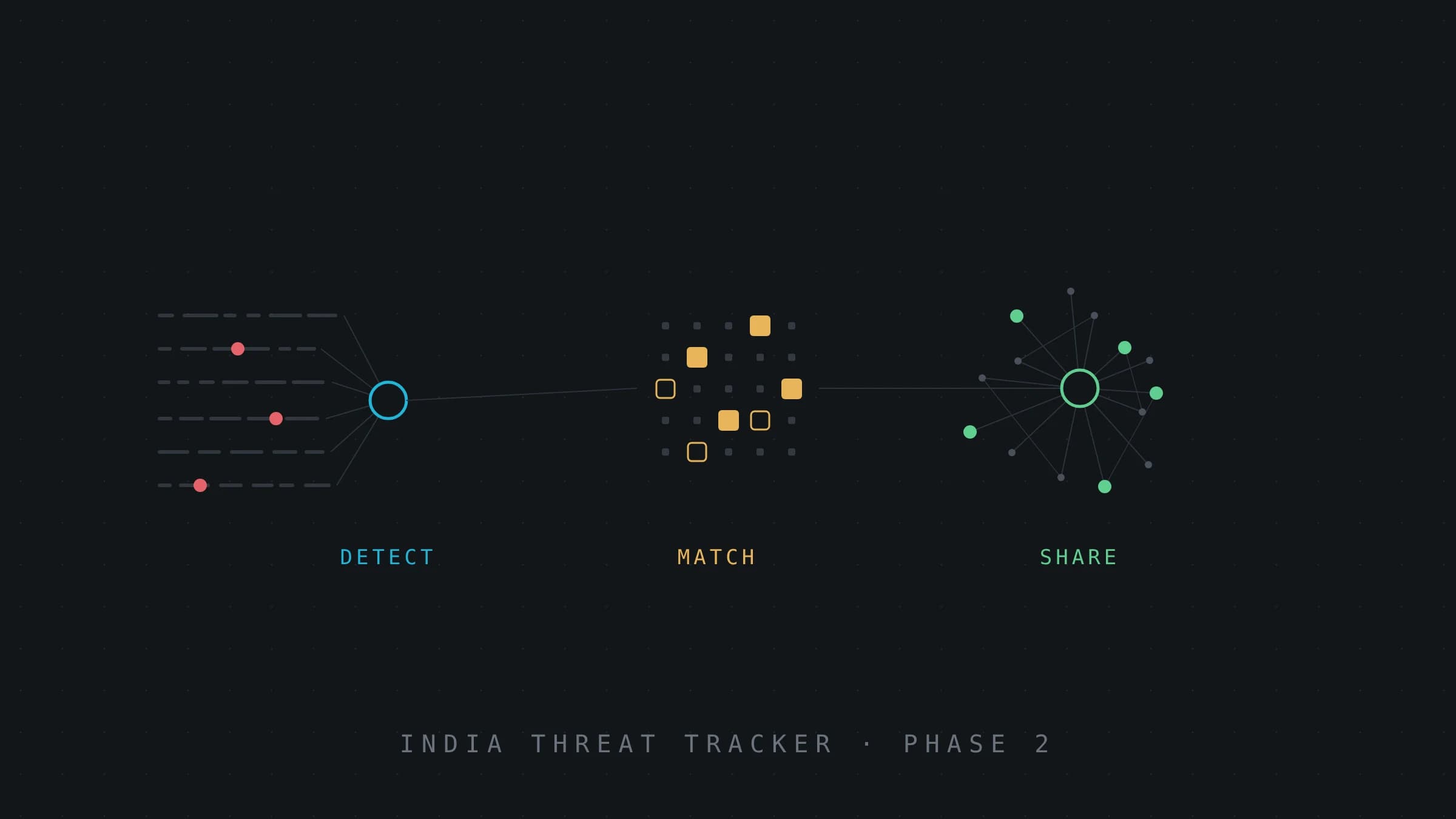
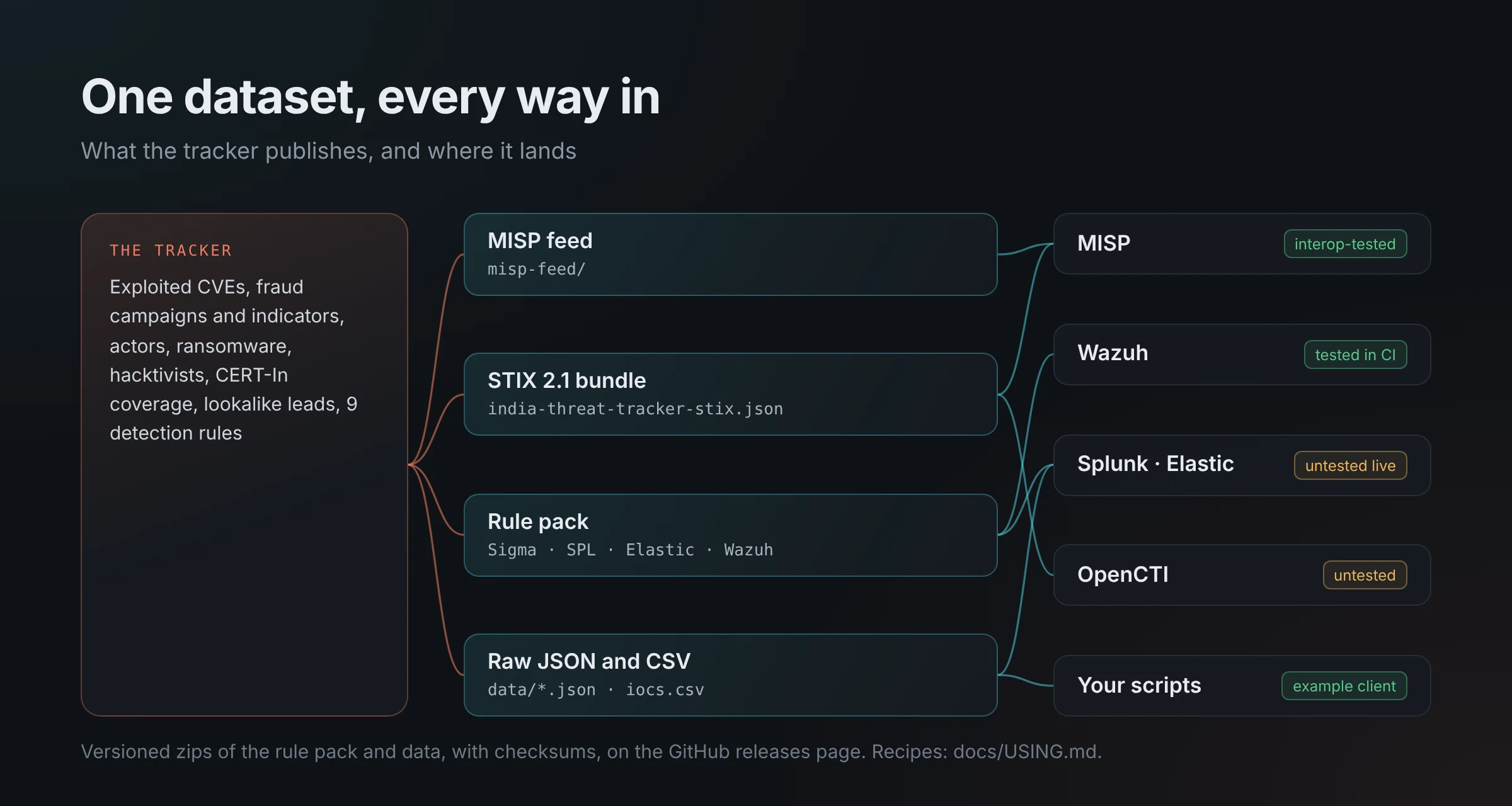 How the tracker reaches your tools
There are also versioned releases now. Each release has the rule pack (Sigma, Splunk, Elastic and Wazuh, with test events) and the full data as zips, with checksums. Pin one if you need the data to sit still while you test. And there's a new guide for using it in a SOC, with recipes for MISP, Wazuh, Splunk, Elastic and OpenCTI, each marked tested or untested.
2. Did CERT-In warn India first?
This is the question I've wanted to answer since the tracker started. CISA's KEV list tells you a flaw is being exploited. CERT-In, India's national CERT, publishes vulnerability notes for most vendor security releases. So for every India-relevant flaw on KEV, did CERT-In publish a note naming it, and was it before or after the flaw was known to be exploited?
The tracker now reads CERT-In's notes itself, a small batch at a time (one request a second, at most 150 per run), and matches them to KEV by CVE ID. The first few days of runs will backfill this year and last year, so most entries start out as pending. I set one rule I won't bend: "no CERT-In note" is never shown until every note in the window has been checked. A half-finished scan that says "CERT-In missed this" would be a false claim.
The five notes I checked by hand already show why this is worth doing:
- PHP2Shell. CISA added two PHP flaws to KEV on 26 October. CERT-In's note CIVN-2026-0528 came the next day, which is quick. But the note names only one of the two CVEs. The other may be in a different note, and the scan will settle that.
- GitLab. CERT-In's 22 October note on GitLab lists twelve CVEs. The GitLab flaw CISA added on 29 October isn't one of them. Again, it may turn up in a later note.
I'm not drawing conclusions from five notes. When the backfill finishes I'll write up what the full picture says. The method is in the methodology, and the data is in certin-gap.json and certin-notes.json.
3. A daily watch on fake bank and government domains
Most of the fake-APK fraud in the tracker starts with a domain that looks like something people trust: a bank, a UPI app, the e-Challan portal. So the tracker now watches for them.
Every day it generates about 13,700 lookalikes of 15 Indian brands: SBI, HDFC, ICICI, Axis, Kotak, PNB, Bank of Baroda, NPCI/BHIM, Paytm, PhonePe, India Post, Income Tax, Parivahan, EPFO and UIDAI. That covers typos (hdfcbnk), hyphens, scam words added to the name (sbi-kyc, parivahan-challan, epfindia-refund) and swapped domain endings. It resolves every one and keeps the ones that exist.
The first scan becomes the baseline. After that, anything newly registered is flagged, and for new ones the tracker asks certificate transparency logs whether a TLS certificate has been issued. A brand-new lookalike with a fresh certificate is usually a live site.
These are leads, not verdicts, and the page says so. A lookalike can be parked, unrelated, or registered by the bank itself to stop exactly this. Nothing is marked for blocking. The point is to see new ones early, then have a human look.
I left two things out on purpose. Unicode lookalikes (homographs) multiplied the candidates more than tenfold for very little gain against Indian brand names. And very short names like sbi only get the scam-word variants, because typos of three letters are mostly real, unrelated websites.
4. Where my detections stop
The tracker maps every actor to MITRE ATT&CK techniques, and every detection rule is tagged with the techniques it targets. Put the two together and you can see the coverage. It's not flattering, and I think that's the useful part.
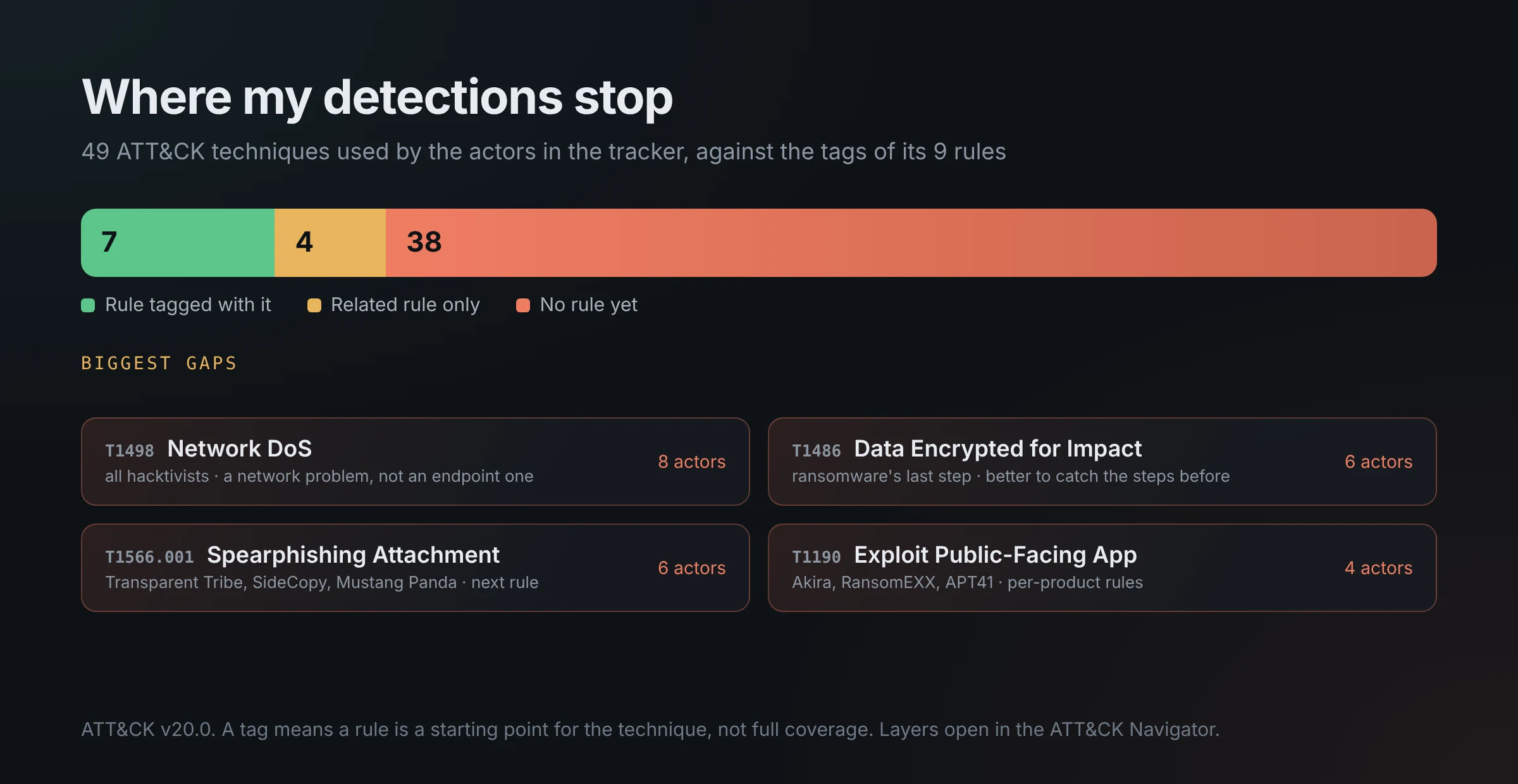 ATT&CK coverage of the tracker's rules
Of the 49 Enterprise techniques used by the state-nexus, ransomware and hacktivist actors in the tracker, 7 have a rule tagged with that exact technique, 4 have a rule for a related one, and 38 have nothing yet. The biggest gaps:
- DDoS (8 actors). All of them hacktivists. This belongs in network monitoring and the CDN, not an endpoint rule, so it may stay a gap.
- Data Encrypted for Impact (6). Ransomware's last step. By the time it fires you've lost, so I'd rather cover the steps before it, like the new Group Policy rule does.
- Spearphishing Attachment (6). This is how Transparent Tribe, SideCopy, Mustang Panda and others get in. My rules catch what happens when the attachment runs, not the email itself. That's the next rule to write.
- Exploit Public-Facing Application (4). How Akira, RansomEXX and APT41 got in, and the same story as every Ivanti, Fortinet and PAN-OS entry on the watchlist. Hard to detect generically, but worth trying per product.
All of this is published as ATT&CK Navigator layers, so you can open them in MITRE's own tool from the tracker page. There's also a Mobile layer for the fake-APK campaigns. While building this I also started checking every technique ID in the data against ATT&CK v20 in CI. It caught one of my own mistakes straight away: a fraud campaign was mapped to an Enterprise technique that doesn't exist in Mobile ATT&CK. That's fixed, and CI will now catch the next one.
What's still not claimed
- Every rule is experimental. The Splunk and Elastic queries haven't run on a live stack.
- OpenCTI import is untested.
- The CERT-In reader was tested against pages shaped like CERT-In's, not the live site. If the real pages read differently, the scan stops at that note and says so rather than skipping it.
- India relevance is still a keyword heuristic.
Try it
- MISP: add the feed URL above.
- Everyone else: grab the zips from the releases page, or start with the SOC guide.
- Want your bank or brand watched for lookalikes? Add it to
config/lookalike-brands.jsonin a pull request.
If something breaks or a rule fires on something legitimate, open an issue. That's how the next version gets better.
Sources
Related research
More deep dives →