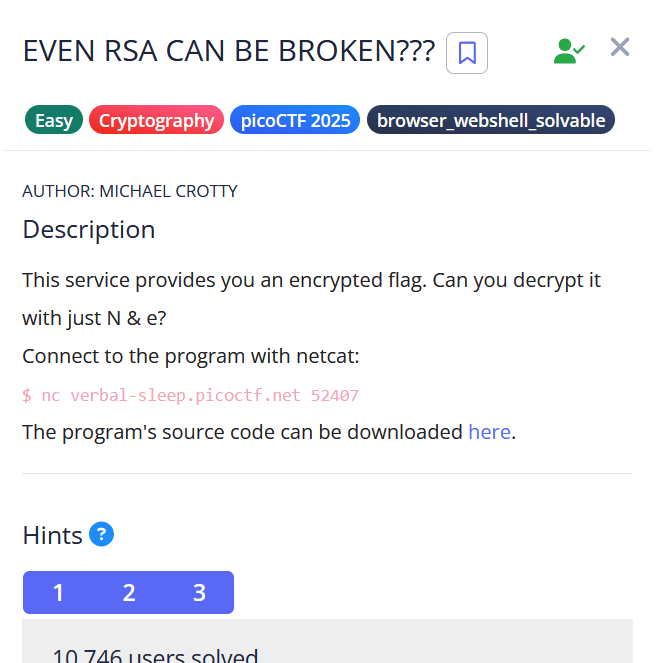
EVEN RSA CAN BE BROKEN???
Challenge Description
Solution and Analysis
So we are given an interface to connect with to get the challenge as shown
└─$ nc verbal-sleep.picoctf.net 52407
N: 15670486633893804323762212898637871667941398551553578363563974262544320326343226952124610464821239940822183541368003266183968698469079838930901694272149938
e: 65537
cyphertext: 310102334696548197739612678442676178490285386313271835684795664800269603703092004716398389311274125654000177546456200342351279763176030718474728195357539
In RSA encryption, e, n, and c are essential public components used to lock a message.
Think of it like sending a secret message using a public lockbox. 📦
n (The Modulus): The Lockbox
n is a very large public number. It acts as the lockbox itself. It's created by multiplying two secret, large prime numbers. Everyone can see and use this lockbox, but only the intended recipient has the key to open it.
e (The Public Exponent): The "Lock" Button
e is another public number that acts as the "lock" button on the box. Anyone can take a message, place it inside the lockbox (n), and press this button (e) to securely lock it. A common choice for e is 65537 because it makes the locking process fast.
c (The Ciphertext): The Locked Message
c is the scrambled, unreadable message after it has been locked. This is what's actually sent over the internet. It's calculated by taking the original message (m) and applying the public values in a formula:
$$c = m^e \pmod$$
To anyone else, c looks like random numbers. Only the person with the corresponding private key can unlock the box and reveal the original message m.
To decrypt this message we can use online tools, one such is https://www.dcode.fr/rsa-cipher