One Patch Behind: A WHO Staging Chatbot Running a Rasa Version With a Critical RCE
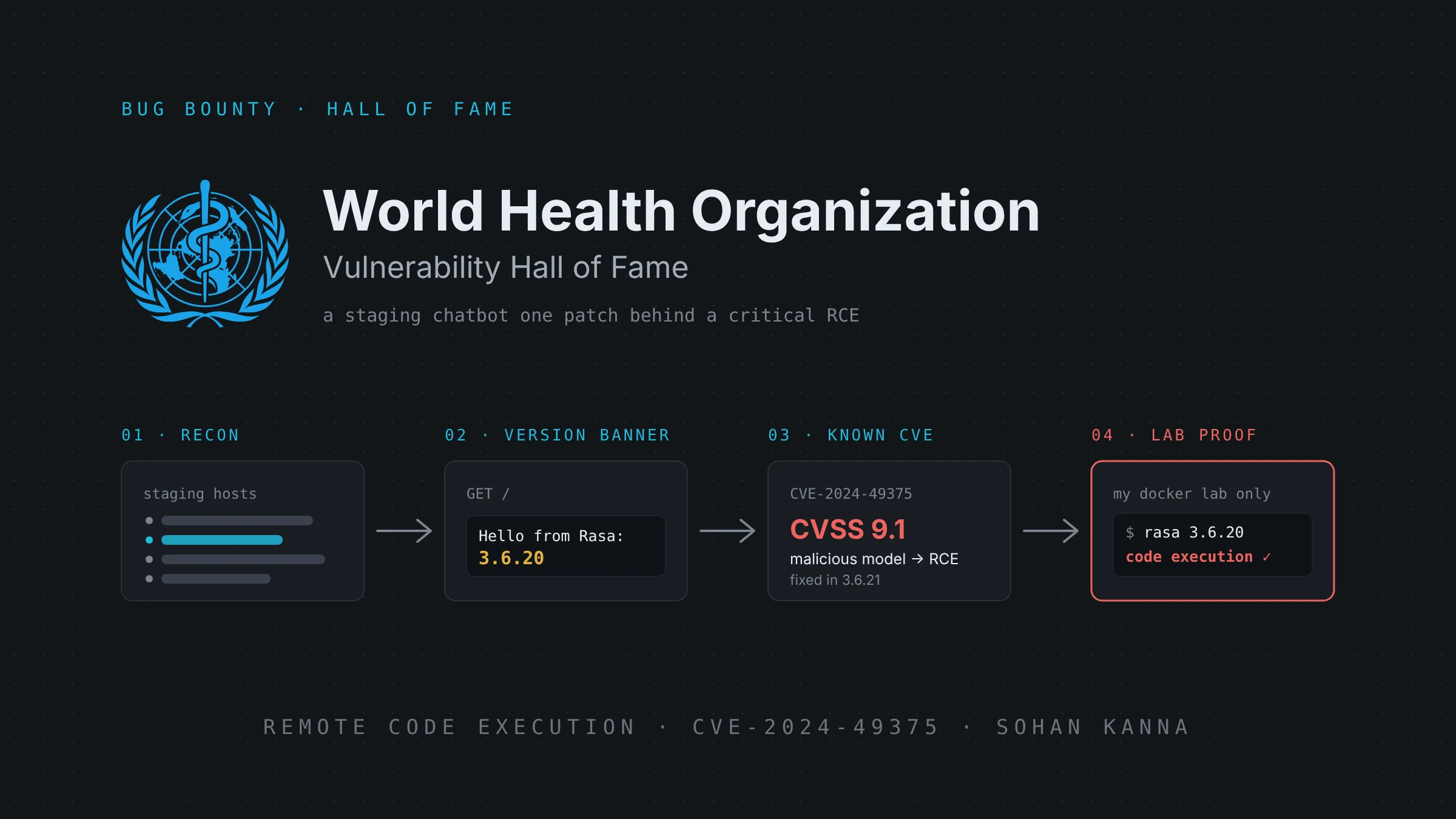
A staging chatbot on a WHO subdomain announced its own version in plain text, and that version was one release short of the fix for CVE-2024-49375, a CVSS 9.1 remote code execution bug. Here's how I found it, proved it in my own lab without touching WHO's server, and got it fixed.

- Severity
- Critical
- Class
- Remote code execution (known CVE)
- Status
- Fixed
On this page
This is the bug that got me into the World Health Organization's Hall of Fame, and the interesting part isn't an exploit. It's a version number, a public CVE, and deciding how far you're allowed to go to prove a point.
TL;DR
- While going through WHO's staging environments, I found a chatbot built on Rasa, the open-source conversational AI framework, reachable from the internet.
- A plain
GET /answeredHello from Rasa: 3.6.20. - Rasa 3.6.20 is affected by CVE-2024-49375, a CVSS 9.1 remote code execution bug. The fix shipped in 3.6.21, one release later.
- I sent only read-only GET requests to WHO's server. I proved code execution against my own Rasa 3.6.20 lab instead.
- WHO accepted the report, took the service down, and listed me in their Vulnerability Hall of Fame for remote code execution.
Hostnames, internal service names and the name of the person who replied are redacted. No exploit code is included, and none was ever sent to WHO.
Four reports, one Hall of Fame
Bug bounty isn't all wins, so here's the honest count. I sent WHO four reports:
- Two were duplicates. Someone had reported them first.
- One got a "we'll pass this to the relevant team" reply.
- One, the chatbot below, was accepted.
One of the other reports was a Grafana instance where a dashboard folder named Public could be viewed without signing in:
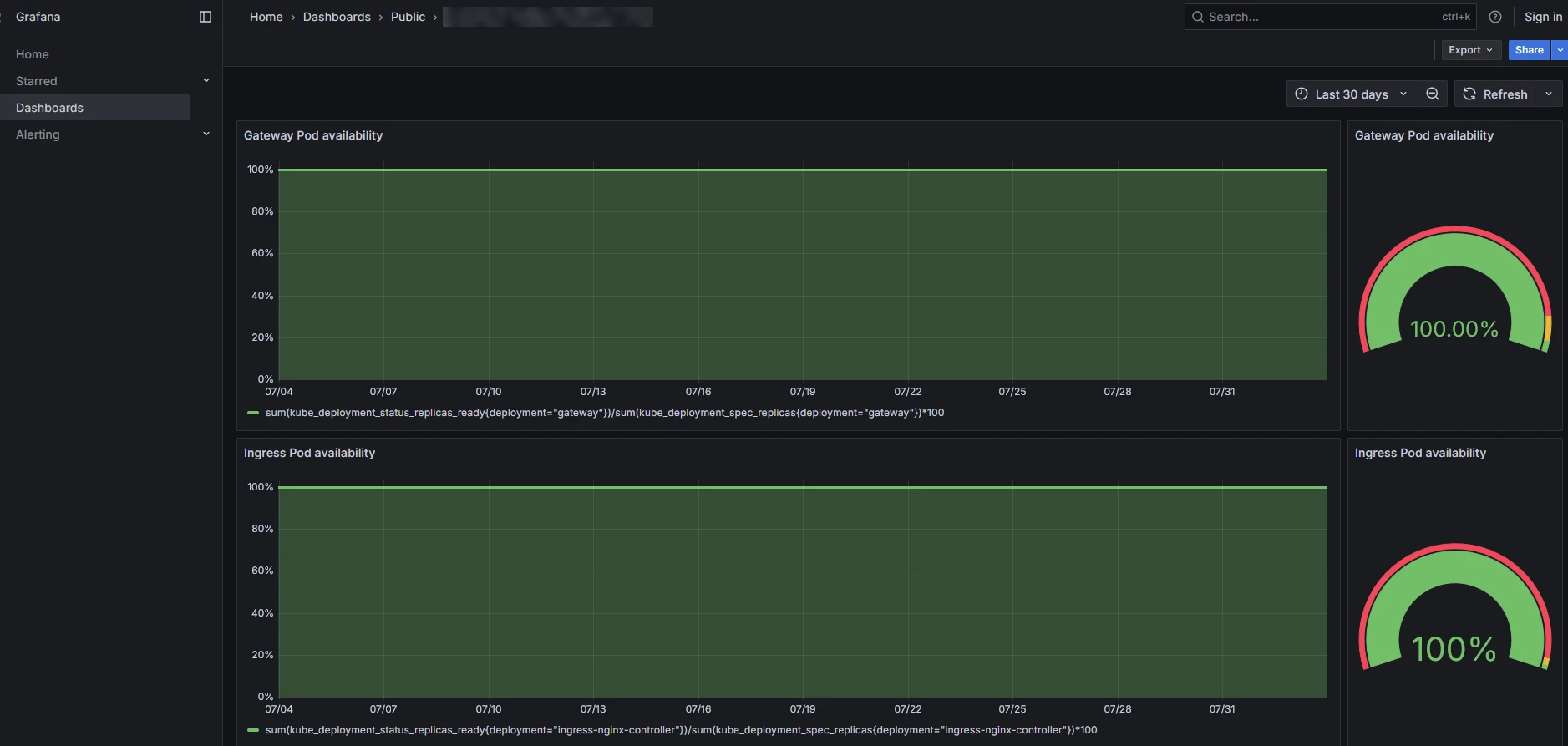 A Grafana dashboard on a WHO staging host, viewable without logging in (note "Sign in" at the top right). Dashboard name blurred.
It showed Kubernetes pod availability for the gateway and ingress controller, including the PromQL queries and deployment names behind each panel. It isn't critical on its own, but it's exactly the kind of internal detail that helps an attacker map an environment. It also told me these staging environments were worth a closer look.
Finding the chatbot
Among the staging hosts was one whose name made it obvious it ran a Rasa chatbot. I requested its root page:
GET / HTTP/1.1
Host: [redacted staging host]
Hello from Rasa: 3.6.20
That's Rasa's default root response, and it includes the exact version. No fingerprinting needed. The server told me.
Is 3.6.20 vulnerable?
Yes. CVE-2024-49375 (GHSA-cpv4-ggrr-7j9v) affects Rasa Open Source before 3.6.21 and several Rasa Pro versions. It was found by Julian Scheid at Telekom Security and scored 9.1, critical.
In short, Rasa models are archives that get unpacked and loaded when the server uses them. Several built-in components deserialize data from those archives unsafely (CWE-502), so if an attacker can get the server to load a malicious model, they run code on it. The conditions are:
| Condition | What it means |
|---|---|
HTTP API enabled (--enable-api) | Not the default, but common in deployments that load models remotely |
| No API authentication | Anyone who can reach the API gets unauthenticated RCE |
| Token or JWT authentication | Still authenticated RCE for anyone holding a token |
How far I went, and where I stopped
I poked the routes with plain GET requests only:
GET /model/parsereturned HTTP 503 withupstream connect error or disconnect/reset before headers. That's a proxy or service-mesh error, which means the route was wired through to something rather than being an unknown path./model,/status,/version,/healthand/webhooks/rest/webhookall returned a custom 404 page from the same intermediate layer, not from Rasa itself.
So a mesh or proxy sat in front of the app, and some routes made it through. The only way to find out whether the dangerous model-loading endpoints were reachable was to send POST and PUT requests, and that crosses from looking into attacking. WHO's rules are clear: don't disrupt services, don't access private data. I stopped there.
To show the version really was exploitable, I built a local lab instead:
- Rasa Open Source 3.6.20 in Docker
- HTTP API enabled, no authentication
- A public proof of concept, run only against my lab
It worked: code execution confirmed in the lab. WHO's server never received a malicious model, a POST or PUT, or anything other than GET requests.
Why it's critical
If the model-loading API was reachable without authentication, which is what my lab reproduced, an attacker could:
- Run arbitrary code inside the chatbot's container
- Read environment variables, configuration and service credentials available to it
- Move sideways to whatever that workload's network access and service account allow
- Use a "harmless" staging box as a foothold in the rest of the environment
And even with the mesh blocking the dangerous routes, an internet-facing staging service announcing a critically vulnerable version is attack surface that doesn't need to exist.
Accepted, fixed, listed
WHO replied that the report was accepted and that they'd let me know once it was fixed:
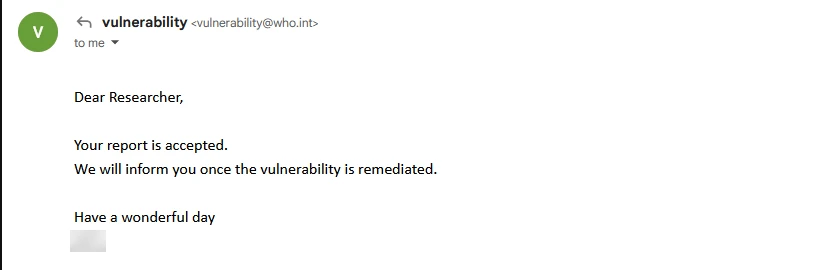 WHO's reply: "Your report is accepted." Sender's initials blurred.
When I checked the host again later, the chatbot was gone. The platform now serves its default "Application is not available" page:
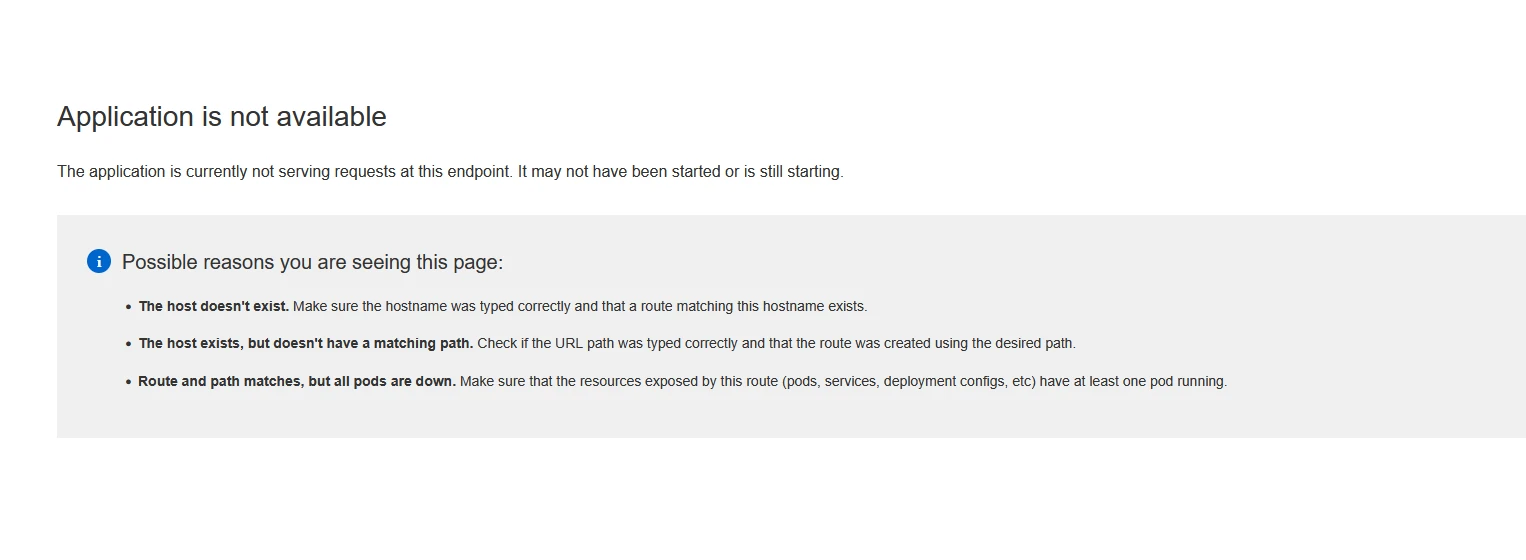 The same host today: the chatbot no longer exists.
Then my name went up on WHO's Vulnerability Hall of Fame: Sohan Kanna D, Reported Remote Code Execution, dated 20 August 2026. You can check it on WHO's ethical hacker list.
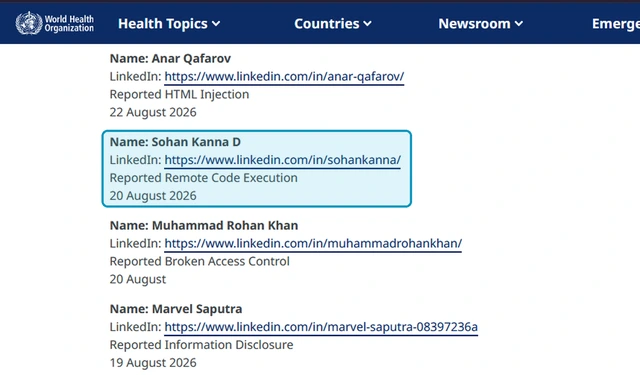 My entry in the WHO Vulnerability Hall of Fame, highlighted.
How to fix it
| # | What went wrong | Fix |
|---|---|---|
| 1 | Rasa 3.6.20 was one release behind a critical fix | Upgrade to 3.6.21 or a currently supported release, then retrain the model on the fixed version |
| 2 | A staging chatbot was reachable from the internet | Keep staging behind a VPN, an IP allowlist or private networking |
| 3 | Model-loading endpoints could sit behind an open API | If the HTTP API is needed, turn on authentication, and only load models from trusted sources such as your own CI, verified by hash |
| 4 | The server announced its exact version | Don't expose version banners publicly; they turn a scan into a lookup |
| + | Staging gets less patching attention | Track staging dependencies with the same tooling and urgency as production |
Timeline
| Date | What happened |
|---|---|
| 2026 | Reported the chatbot, the Grafana dashboard and two other issues to WHO |
| 2026 | WHO accepted the chatbot report |
| 20 Aug 2026 | Listed in the WHO Vulnerability Hall of Fame for remote code execution |
| 12 Nov 2026 | This write-up published, after WHO's 90-day confidentiality period, with sensitive details redacted |
What I took away from it
- Version banners are free findings. One
GET /gave me the exact version; the CVE database did the rest. - Check staging and UAT hosts. They run the same software as production with less patching and less monitoring.
- AI and chatbot frameworks are attack surface too. Rasa, LLM front ends and agent platforms load models and files that can execute code.
- When proving it means attacking it, prove it somewhere else. A local lab on the exact version made the report convincing without a single exploit request to WHO.
- Duplicates happen. Two of my four reports were already known. Keep going.